How the professionals frame a football or rugby shirt — stitch-mounting, deep shadow-box frames and UV glass — plus an honest look at DIY shirt frames, match-worn kit and what to expect on cost and turnaround.
Search “how to frame a football shirt” and you’ll find plenty of adverts dressed up as advice. This is the actual answer, for both codes: the decisions to make before anything gets framed, the method professional framers use and why, an honest look at doing it yourself, what changes the moment a shirt is signed, and what changes again when it’s a heavier rugby shirt. It’s the same process behind every shirt that comes through our Timperley workshop — whether it arrives for football shirt framing or rugby shirt framing — and there are no secrets in it.
First, decide how the shirt should sit
Before frames, glass or mounting come into it, three decisions shape everything else:
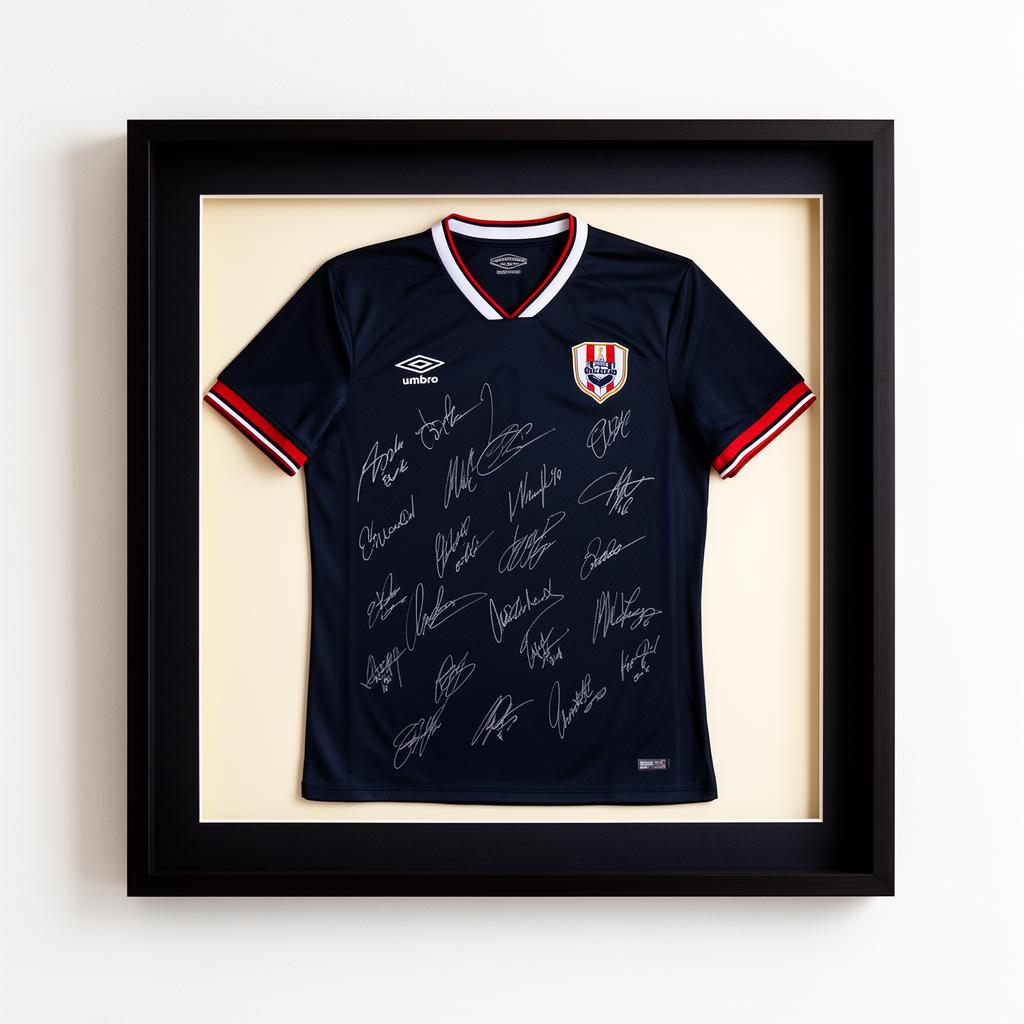
- Folded or full-front? Folded once across the middle is the classic look — it concentrates the eye on the badge, sponsor and any signature, and keeps the frame a manageable size. Full-front shows the entire shirt and suits kits where the whole design is the point, at the cost of a noticeably bigger frame.
- Sleeves shown or tucked? Tucking the sleeves behind the body gives a clean, gallery-style rectangle. Showing them adds width but matters when the story is on the sleeve — league patches, finals embroidery, a captain’s armband era.
- Which side tells the story? A shirt only has one face in a frame. Badge and sponsor forward is the default; if the name, number or a signature across the back is what makes the shirt special, the back faces out. Decide this before anything else — it drives the fold, the mount and the frame size.
How professional framers do it, step by step
There’s nothing exotic about proper shirt framing — it’s just the right materials, in the right order, with no shortcuts.
1. Build a box, not a frame. A shirt has depth, and a standard picture frame has a rebate of a centimetre or so. A proper shirt frame is a deep shadow box — typically a 35–55mm rebate for a football shirt, 50–65mm for heavier rugby kit (see the rugby section below) — so the fabric sits in its own space and never presses against the glazing.
2. Cut a shirt form from acid-free board. The shirt is dressed over an acid-free foamboard form cut to its exact size. That’s what gives the shoulders and body their soft structure and keeps every fold exactly where it was placed. Acid-free matters: ordinary board slowly yellows fabric over the years.
3. Stitch — never pin, never glue. The shirt is anchored to the board with dozens of hidden stitches in conservation-grade cotton thread, worked through seams and hems wherever possible. Spreading the weight across that many tiny anchor points is what stops the slow sag you see in badly framed shirts, and every stitch can be snipped later, leaving only tiny needle marks in the seams — invisible from the front. Pins rust and pull holes; glue is permanent and ruinous near a signature. Neither belongs anywhere near a shirt.
4. Acid-free mount and backing throughout. The board behind the shirt and the backing that seals the frame are conservation-grade, for the same reasons we set out in our guide to conservation picture framing: everything touching the piece must be inert, and everything must be undoable.
5. UV-protective glazing. Kit dyes fade, and signature ink fades far faster. UV-protective glass is standard on every sports frame we build — it blocks the wavelengths that bleach colour out of a shirt hung in a bright room.
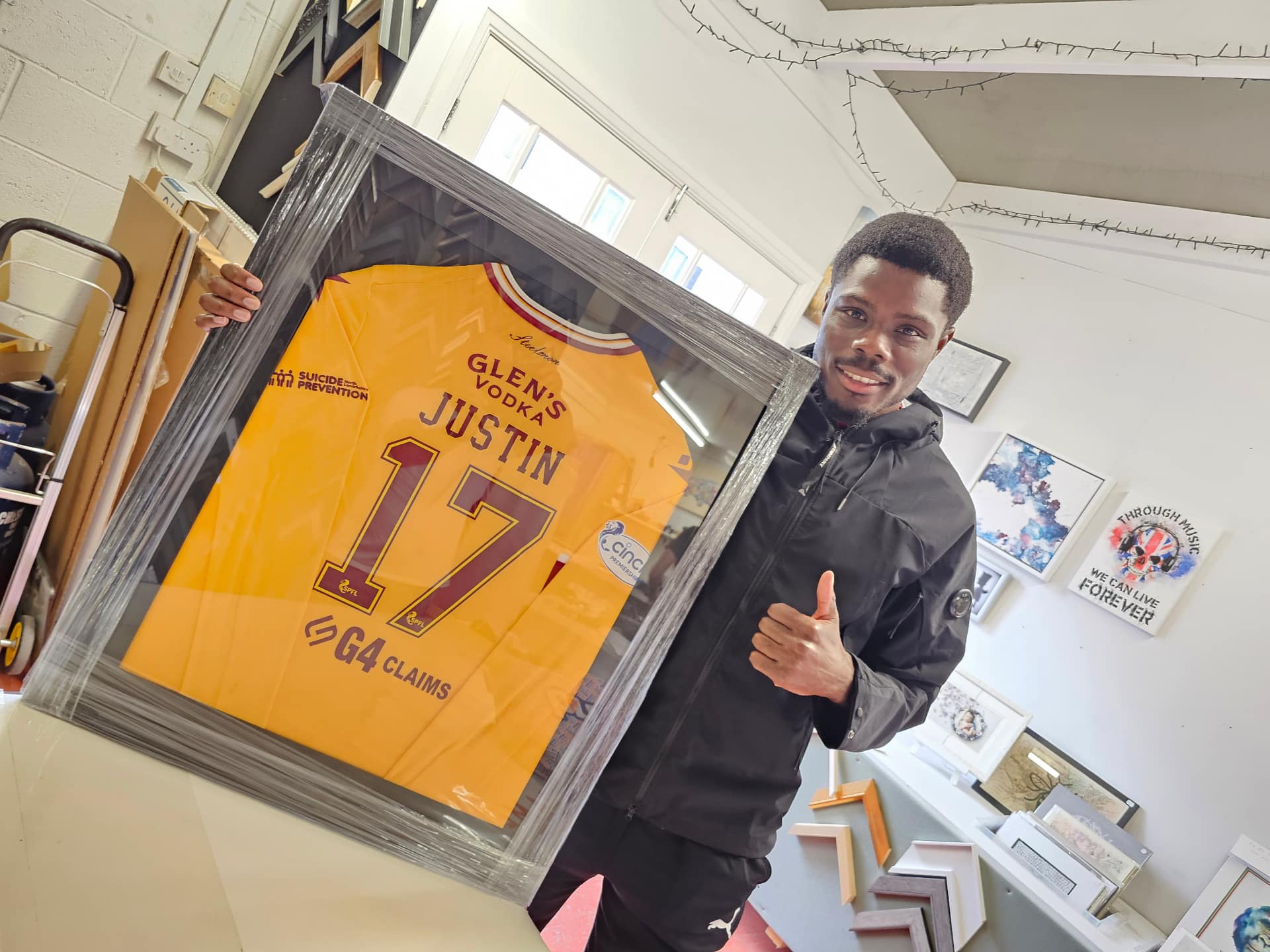
Framing a football or rugby shirt yourself
Can you do it yourself? Honestly — sometimes, yes. Flat-pack shirt frames from high-street shops and online retailers are inexpensive, arrive with everything included, and can be done in an evening. For the right shirt, that’s a perfectly sensible choice, and we’d rather you framed a shirt cheaply than left it in a drawer.
The problems are in how they’re built. Most kits hold the shirt with pins pushed through the fabric, which stretch and sag around each pin and can rust into the fibres. The boxes are often too shallow, so the shirt is crushed flat against the glazing and creases where it touches. The glazing is usually standard acrylic with no UV protection, so colours and signatures fade on a bright wall. And the backing boards are rarely acid-free. None of that matters much for a replica you could buy again tomorrow. All of it matters for a shirt you couldn’t. Rugby adds one more problem: almost every flat-pack kit is sized for a football shirt, and a heavyweight collared rugby shirt simply will not lie flat in one.
| Feature | Flat-pack shirt frame | Bespoke shadow box |
|---|---|---|
| Mounting | Pins or clips through the fabric | Hidden stitching — no pins, no glue |
| Depth | Often shallow; shirt pressed on glazing | 35–55mm (football) / 50–65mm (rugby); shirt sits clear |
| Glazing | Standard acrylic, rarely UV-rated | UV-protective glass as standard |
| Boards | Rarely acid-free | Acid-free and conservation-grade throughout |
| Over time | Sagging and fading are common | Holds its position; resists fading |
| Best for | Unsigned replicas, short-term display | Signed, match-worn, retro — anything irreplaceable |
A fair rule of thumb: if the shirt is replaceable, a DIY frame is fine. If it isn’t — signed, match-worn, a grandfather’s kit, a one-off — the mounting method and the glazing are worth doing properly, once.
Framing a signed shirt: the rules change
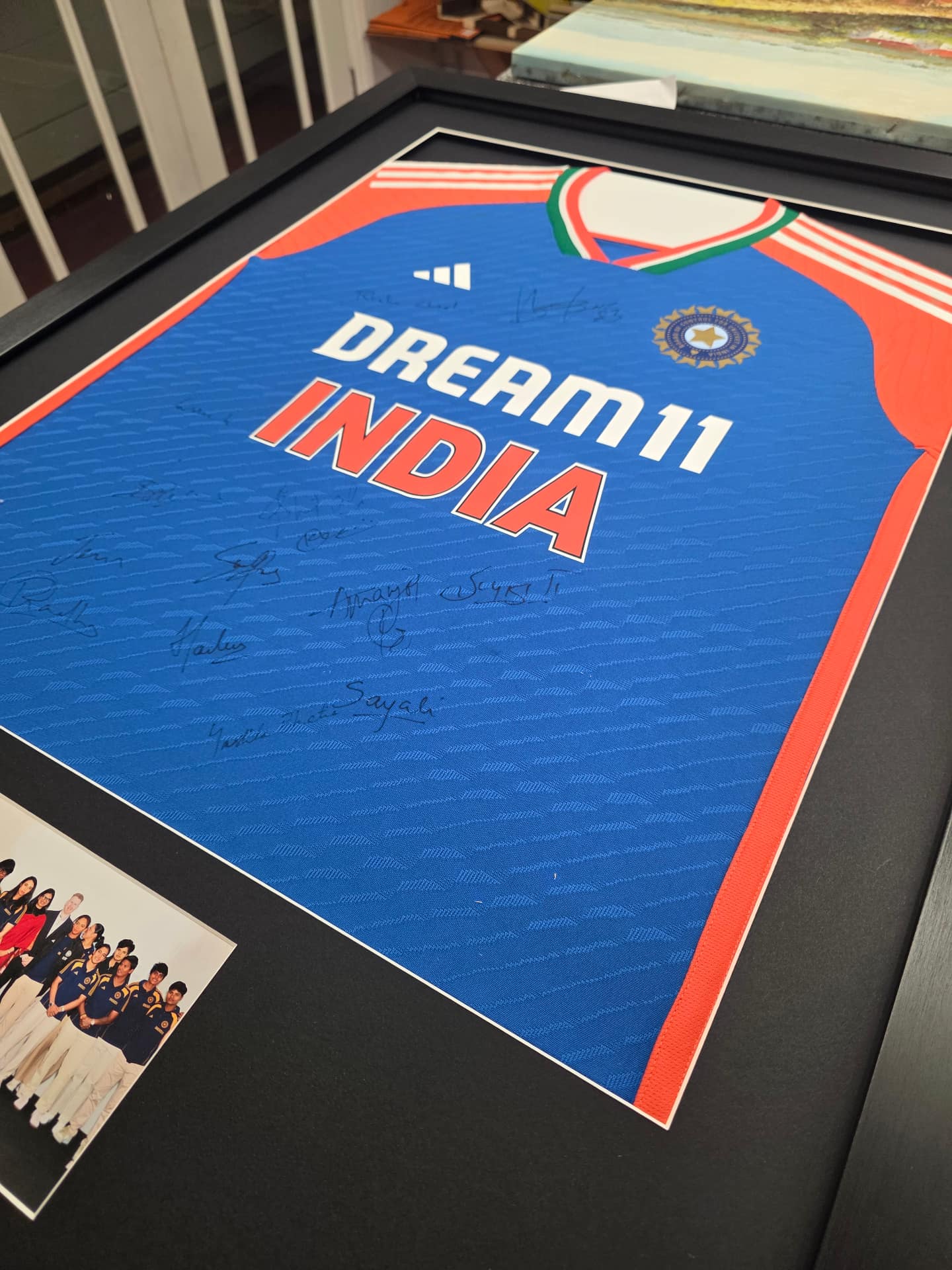
The moment a shirt is signed, it stops being clothing and becomes a document. Three rules follow:
Never wash or iron it again. Detergent, water and heat all destroy autograph ink — even steam from ironing the other side of the fabric can blur a signature. Whatever state the shirt was in when it was signed is the state it gets framed in.
Treat UV glazing as non-negotiable. Marker ink is far more fugitive than the dyes in the shirt itself. Behind ordinary glazing on a bright wall, a signature can fade to a ghost within a few years; behind UV-protective glass it stays legible for decades. This is the single biggest difference between a signed shirt that holds its value and one that doesn’t.
Deal with the certificate of authenticity. If the shirt came with a COA, it can be framed into the layout in its own aperture, or fixed in an envelope to the back of the frame. Either way, keep the paperwork with the shirt — for insurance and any future sale, the two belong together.
Framing a rugby shirt: heavier kit, deeper box
A rugby shirt follows exactly the same principles — stitch, never pin; build a box, not a frame; UV glass over anything signed — but several things change, and they change decisions you make before a single cut: the weight of the fabric, the shape of the shirt, and what to do about a shirt that was actually played in.
It needs a deeper box. A football shirt sits comfortably in a 35–55mm rebate. A rugby shirt rarely does. Heavyweight cotton retros, collared club shirts and modern tight-fit polyester replicas are all bulkier through the shoulders, collar and seams, so a rugby shirt wants a 50–65mm rebate to keep the fabric sitting in its own space rather than pressed against the glazing. Add a signed match ball to the layout and it goes deeper again — typically 75–90mm, with a cradle holding the ball and the shirt mounted behind it.
And it needs a mount built to carry the weight. This is the failure you see most often in rugby frames: a heavy shirt hung on a mount board that was specified for a football shirt. A season’s worth of gravity later, the shoulders have dropped, the hem has bowed and the fold has wandered. Heavyweight cotton and modern tight-fit polyester weigh far more than a lightweight football shirt, so the board behind them has to be reinforced and the stitching spread across the shoulders, sleeves and hem rather than concentrated at the top. If you’re judging a quote, it’s a fair question to ask: what is the board behind my shirt, and where is it stitched?
Collars and hoops change the fold. A rugby collar is part of the shirt’s character — it reads best sitting proud and square at the top of the mount, not flattened or tucked away, which usually means keeping the fold well below it. Hooped shirts need more thought again: a fold across the middle cuts a hoop in half and the whole design starts to look like an accident. With hoops we’d usually go full-front, or drop the fold low enough that the banding still reads in rhythm. Long sleeves — far more common in rugby — can be folded behind for a clean rectangle, or shown when there’s a tour patch or a captain’s armband worth seeing.
Match-worn: leave the mud on. If the shirt was actually played in, the mud, grass and pitch marks are not damage — they are the provenance, and they are usually the reason the shirt is worth framing at all. We do not clean them off. Washing throws away the only physical evidence the shirt saw a pitch, and the heat and agitation of a wash are the quickest way to lift a printed number or crack a heat-pressed name. A match-worn shirt gets mounted exactly as it arrives and sealed inside the box, so nothing transfers to the glazing or the mount.
Club colours belong on the mount, not the frame. The mount is where you bring the club into the piece without shouting about it. One rule worth knowing: pick a colour out of the shirt’s trim, collar or badge rather than matching its dominant colour. A red mount behind a red Munster shirt flattens the whole thing; a mount picking up the white or gold in the crest pushes the shirt forward and lets it sit properly on a wall. If you’d rather go understated, a neutral mount never dates.
Everything else is the same for both codes — hidden stitching, conservation boards, UV glass, and 7–10 working days from approved spec. If it’s a rugby shirt you’re framing, our rugby shirt framing page has the layouts and price bands, plus the Lions tour, Six Nations, World Cup, URC and Top 14 work we see most.
Multi-shirt displays and shirt-plus layouts
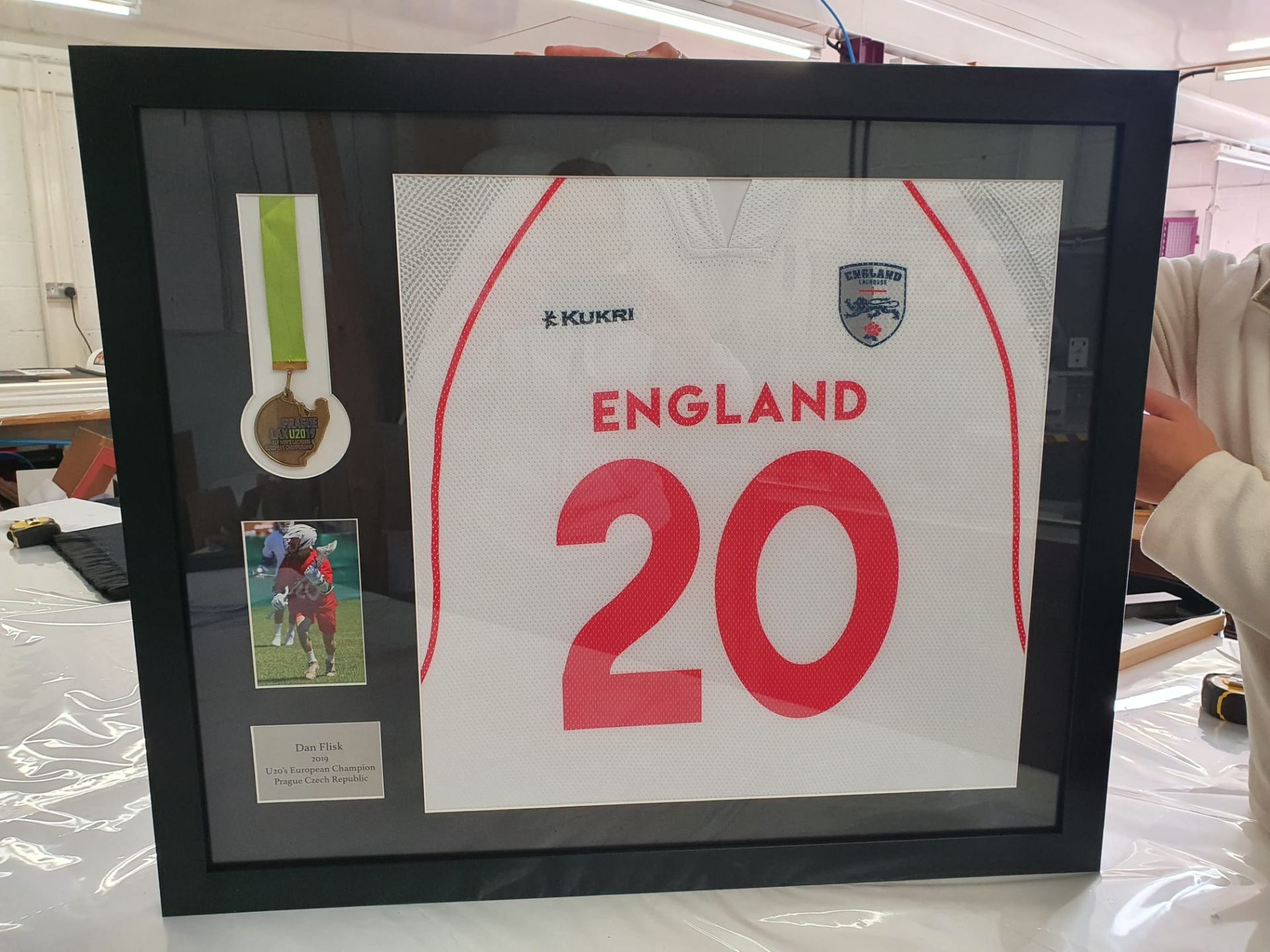
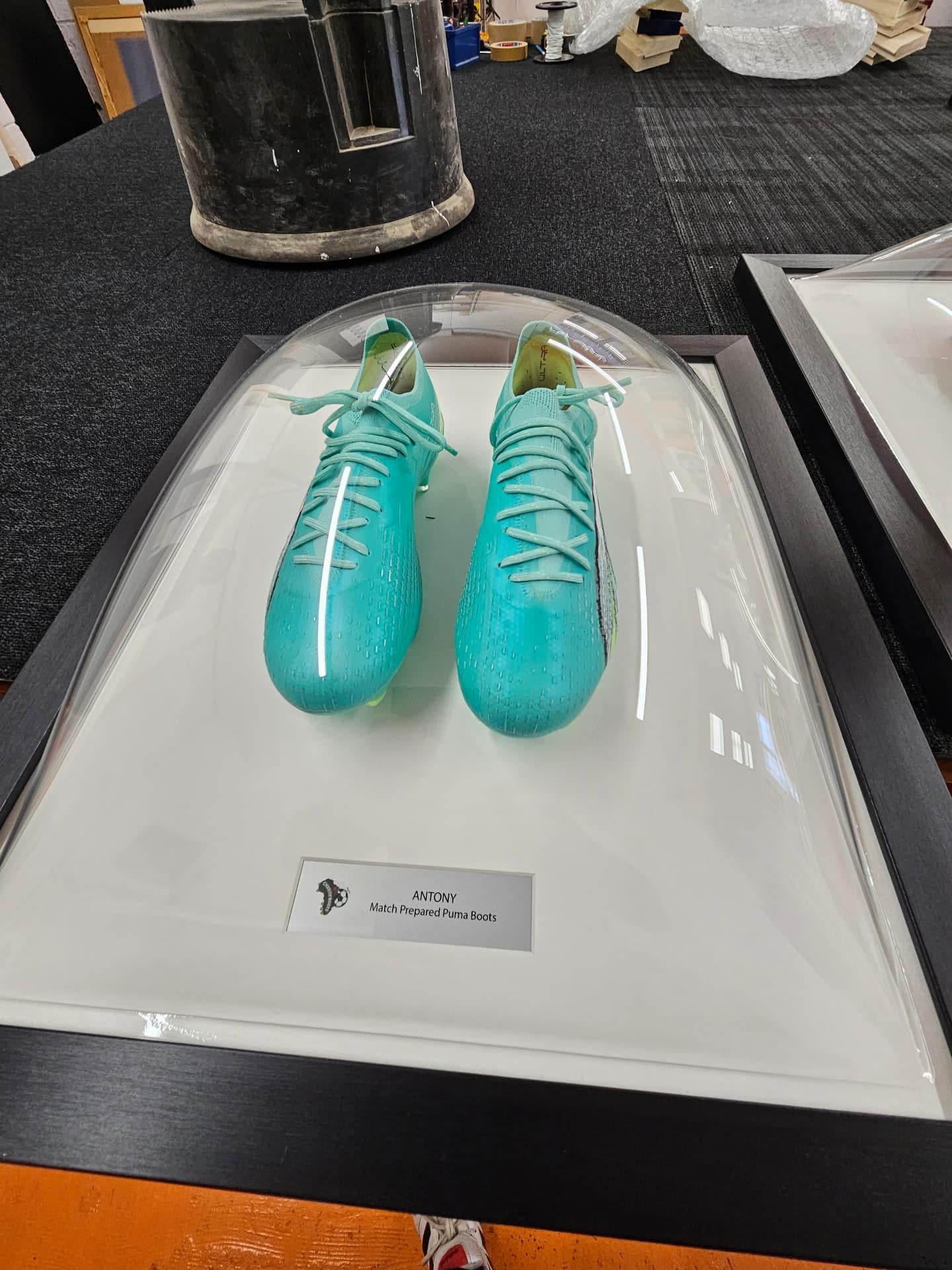
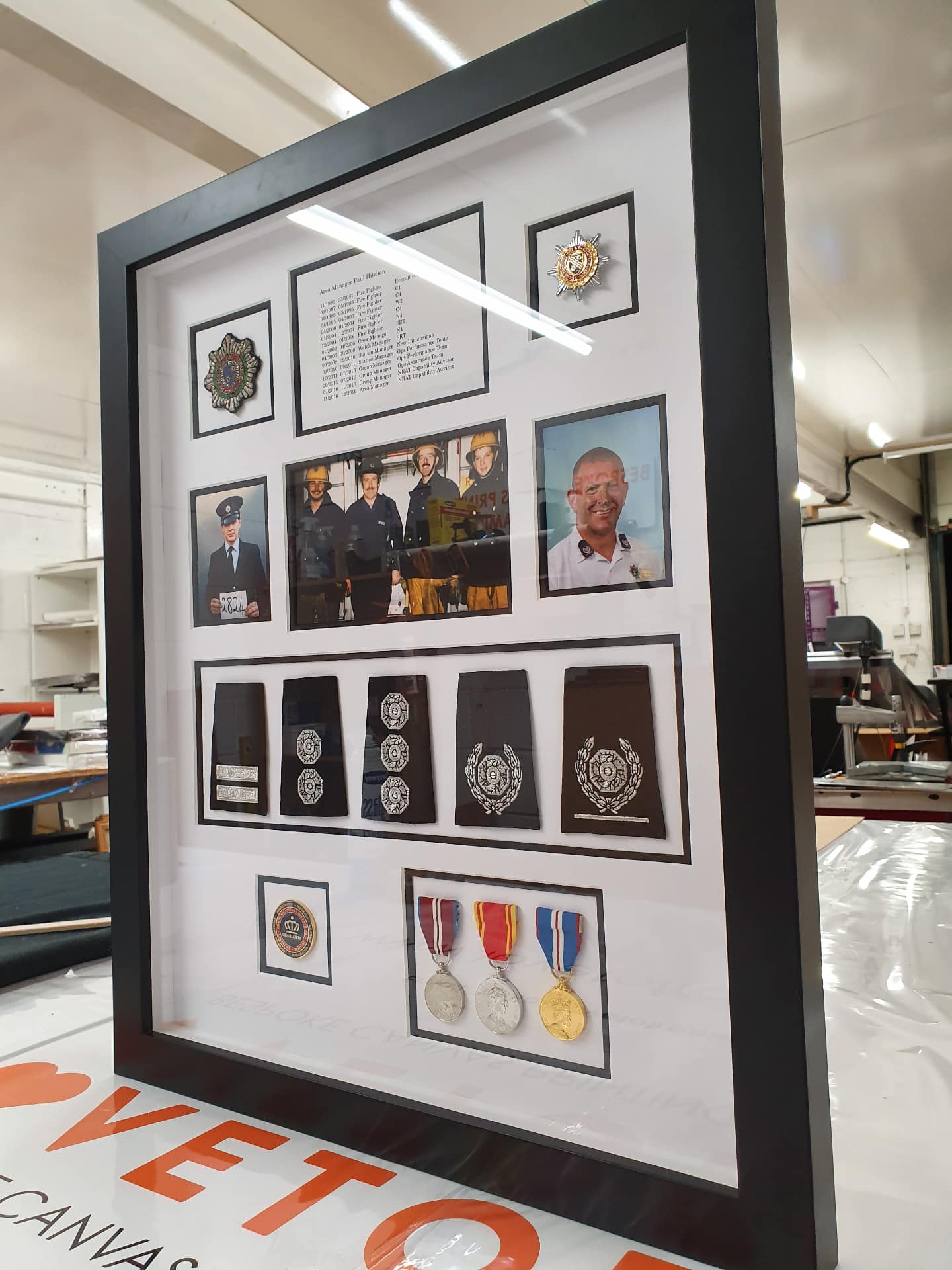
A single folded shirt is the classic, but it’s not the only option. Two, three or four shirts mounted on one continuous board read as a single story — a player’s career arc, a family of season tickets, a home-and-away pair. And a shirt framed with its supporting cast — match programme, ticket stub, photograph, an engraved plaque with the date and score — becomes something closer to an heirloom than a display. We cut multi-aperture mounts to the layout, so each piece has its own window in the same frame.
The same stitch-mounting method works for any kit — the rugby section above covers the heavier fabrics, our medal framing page covers layouts where the medals lead, and memorabilia framing covers everything from boxing gloves to cricket bats. If you’re mixing a shirt with other objects, our guide to framing sports memorabilia walks through the layout decisions.
What it costs and how long it takes
Every shirt frame we build is made to the shirt, so pricing depends on the piece — as an honest anchor, a single signed football shirt in a quality deep-box frame with UV glass typically runs £160–£260, and a signed rugby shirt £180–£290, because rugby kit is bigger, heavier and needs the deeper box. What moves the price: shirt size, folded versus full-front, the moulding you choose, the glass specification, and any extra apertures for photos, medals or a COA. Send us a photo of the shirt and a rough idea of the layout via our football shirt framing page or rugby shirt framing page and we’ll come back with an honest quote — usually the same day.
On timing: bespoke shirt framing runs 7–10 working days from the moment we have the shirt and the approved spec. If you’re working to a birthday or Father’s Day deadline, say so when you enquire — we regularly accommodate rush work. Finished frames are collected from the Timperley workshop or double-boxed and shipped UK-wide by insured courier.
Common questions
Can I wear the shirt again after framing? Treat framing as the shirt’s retirement. The stitching can be undone with care, but tiny needle marks remain in the fabric — invisible from the front, but there. A mounted shirt is a display piece; if you want to keep wearing it, ask us about display cases instead.
Should I wash the shirt before framing? A signed shirt must never be washed or ironed — frame it as it is. Nor should a match-worn shirt whose marks are part of its story: mud and grass are provenance, and a wash risks lifting a printed number. A plain, unsigned shirt that has simply been worn does benefit from a gentle wash and a complete air-dry before mounting.
Do you ever use pins? No. Hidden stitching or acid-free fixings only — pins mark the fabric, rust over time and let the shirt sag around each point.
Can you rescue a shirt from a flat-pack frame? Yes, and it’s one of our most common jobs. We remove the pins, ease out any distortion we can, and remount the shirt properly on fresh conservation board behind UV glass.
If you’d like the shirt done properly first time — or rescued from a frame that isn’t doing it justice — send us a photo and tell us what the shirt means to you. We’ll recommend the right approach honestly, whether that’s a full bespoke shadow box or not.
Ready to start a project?