Order of wear, court versus swing mounting, whether to polish, what to do about perished ribbons and which papers belong in the frame — plain advice from our Timperley workshop.
Medals are the most personal things that come into our Timperley workshop, and the questions people arrive with are almost never about frames. What order do they go in? Should I clean them up first? The ribbon has gone to dust — do I replace it? Do the service papers belong in the frame? Those decisions are yours, not your framer’s, and easier to get right before anything goes behind glass. Here are the honest answers — the build itself, layouts and pricing live on our medal framing page.
Start with the order of wear
Get this wrong and it’s the first thing any old soldier who sees the frame will notice. British medals are worn on the left breast in strict order of precedence, most senior award closest to the centre of the chest. Viewed from the front — which is how the frame will hang — that means senior on the left, junior on the right. The broad sequence runs:
- Gallantry and meritorious awards — the VC and GC lead, then orders of chivalry, then decorations such as the DSO, MC and DFC, then gallantry medals such as the DCM, CGM, MM and DFM.
- Campaign medals and stars, in the order of the campaigns themselves — not the order the medals were issued, which is the usual trap with the Second World War stars.
- Distinguished service medals — the Polar Medal, the Imperial Service Medal, and the police, fire and ambulance service medals for distinguished service.
- Jubilee, coronation and commemorative medals.
- Long service and efficiency awards — Long Service and Good Conduct, the Efficiency Medal and their equivalents.
- Foreign and Commonwealth awards last.
If you aren’t certain, don’t guess, and don’t trust how they were lying in the box — loose medals get shuffled by decades of handling. The official order of wear is published by the Cabinet Office, regimental museums will confirm a group over the phone, and the Orders and Medals Research Society exists for the awkward cases. Whichever route you take, first photograph the group exactly as it is.
Court mounting vs swing mounting
Both describe how medals are held together before they reach a frame. Swing mounting is the traditional arrangement: each medal hangs from its own ribbon on a single pin-backed bar, free to swing and clink against its neighbours — how medals were issued and worn for most of the twentieth century. Court mounting sews those same ribbons to a stiff backing board, so the group sits flat and rigid with the medals slightly overlapping and nothing moving — an arrangement adopted for parade wear, because a swinging group knocks itself about.
| Swing mounting | Court mounting | |
|---|---|---|
| What it is | Each medal hangs free from its own ribbon on a bar | Ribbons sewn to a rigid board; the group sits flat |
| Wear over time | Rims and edges rub with regular wear | Contact between medals is largely eliminated |
| In a frame | Reads as untouched; ribbons show full length | Sits tidier under glass and never shifts |
| Best for | Groups kept exactly as worn or inherited | Groups still worn on parade, or loose medals mounted afresh |
So which should you choose for a frame? Honestly — whichever the group already is. Converting a swing-mounted group to court mounting means unstitching original ribbon and re-sewing it, and to a collector that counts as an alteration. That’s why we frame medals exactly as they arrive unless you ask otherwise, and why we’d query a sequence that looks wrong rather than quietly rearrange a family’s medals. The genuinely open case is a group never mounted at all — then the choice is yours, and best made alongside the layout.
Should you polish them? Almost always, no
This is the most common mistake we see, and the one that can’t be undone. The dark, even toning on an old silver medal is patina — and collectors, museums and auction houses treat it as part of the medal rather than as dirt.
Abrasive metal polish removes metal, not just tarnish. Every pass takes a little off the high points: the monarch’s profile softens, the lettering loses its crispness, and the naming impressed around the rim — the part that ties the medal to a specific person — goes shallow and eventually illegible. A polished group is routinely valued below an untouched one, and on gilt or bronze awards polishing strips the original finish straight off.
What is safe: lifting loose dust with a soft dry brush or a clean dry cloth, and handling medals by their edges with clean dry hands so finger oils don’t sit on the surface. That is the whole list — no water, no dips, no silver polish. If you can see active corrosion rather than tarnish — green verdigris, flaking, crusty deposits — that’s one for an accredited conservator or a reputable medal specialist before anyone touches it. We frame medals precisely as they come to us; we don’t clean them, and we’d gently talk you out of it if you asked.
Perished, faded or missing ribbons
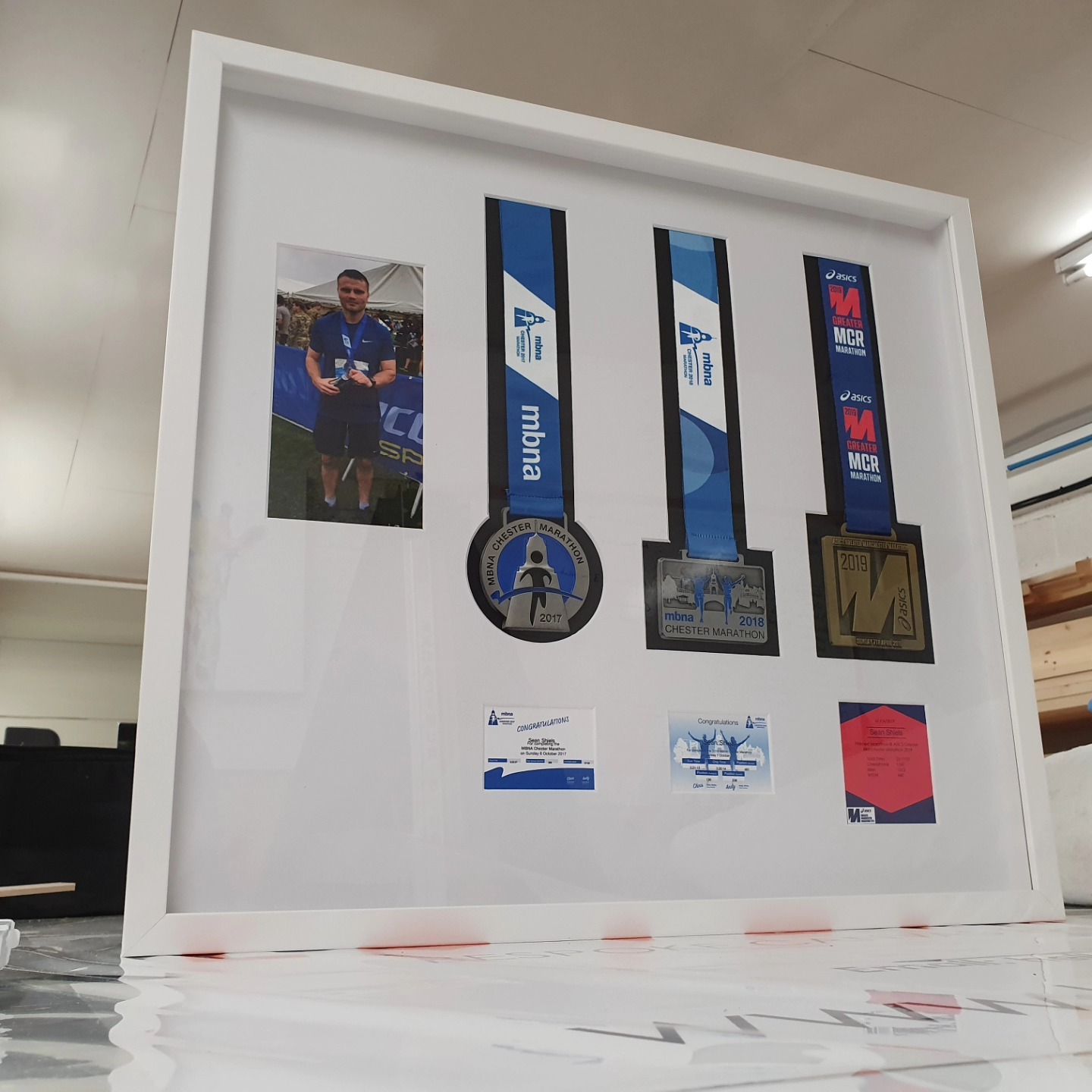
Ribbon has a far shorter life than the metal it carries: eighty-year-old silk fades, frays at the fold and eventually crumbles in the hand. So — keep it or replace it?
Keep the original wherever it still holds together. Faded, frayed, a bit tired — that’s honest wear, and it belongs to the group’s history. New ribbon is bright and uniform, and looks instantly modern beside an old medal.
Replacing is fair when the ribbon has failed — perished past the point of safely carrying the weight of the medal, or missing altogether. Correct ribbon for almost every British award is cheap and easy to source. But don’t throw the old one away: the remains can sit in an acid-free sleeve behind the mount, inside the frame, so they stay with the group for good.
Two things never to do. Never wash a ribbon — water and detergent bleed the dyes and shrink the weave. And never cut one to fit a layout: ribbon length is part of how the medal was worn, so the frame gets designed around the ribbon rather than the other way round.
For ribbon that has faded but is otherwise sound, the answer isn’t restoration, it’s glazing: UV-filtering glass slows further fading once the group is on a wall, and our guide to conservation picture framing explains the protective package behind that.
Researching an inherited group
Inherited medals will often tell you who earned them. Most British campaign medals are officially named: the service number, rank, surname, initials and unit are impressed or engraved around the rim, and that naming is the most valuable information you have. One thing to know before you worry — British Second World War stars and the War Medal were issued unnamed, so a blank 1939–45 group is entirely normal.
Photograph the rim before the group is framed. Once the medals are behind glass, the naming can’t be read again without opening the frame. A sharp, well-lit shot of each named rim is worth keeping with your records — it’s also exactly what an insurer asks for.
From there, the service number and unit open most doors: the National Archives holds First World War service and medal index records, later records sit with the Ministry of Defence and can be requested by next of kin, and regimental museums are usually the most helpful people you’ll speak to. Do this before framing — it regularly turns up a photograph or a citation you’ll want in the layout, and adding a piece at the design stage beats reopening a finished frame.
Which paperwork belongs in the frame
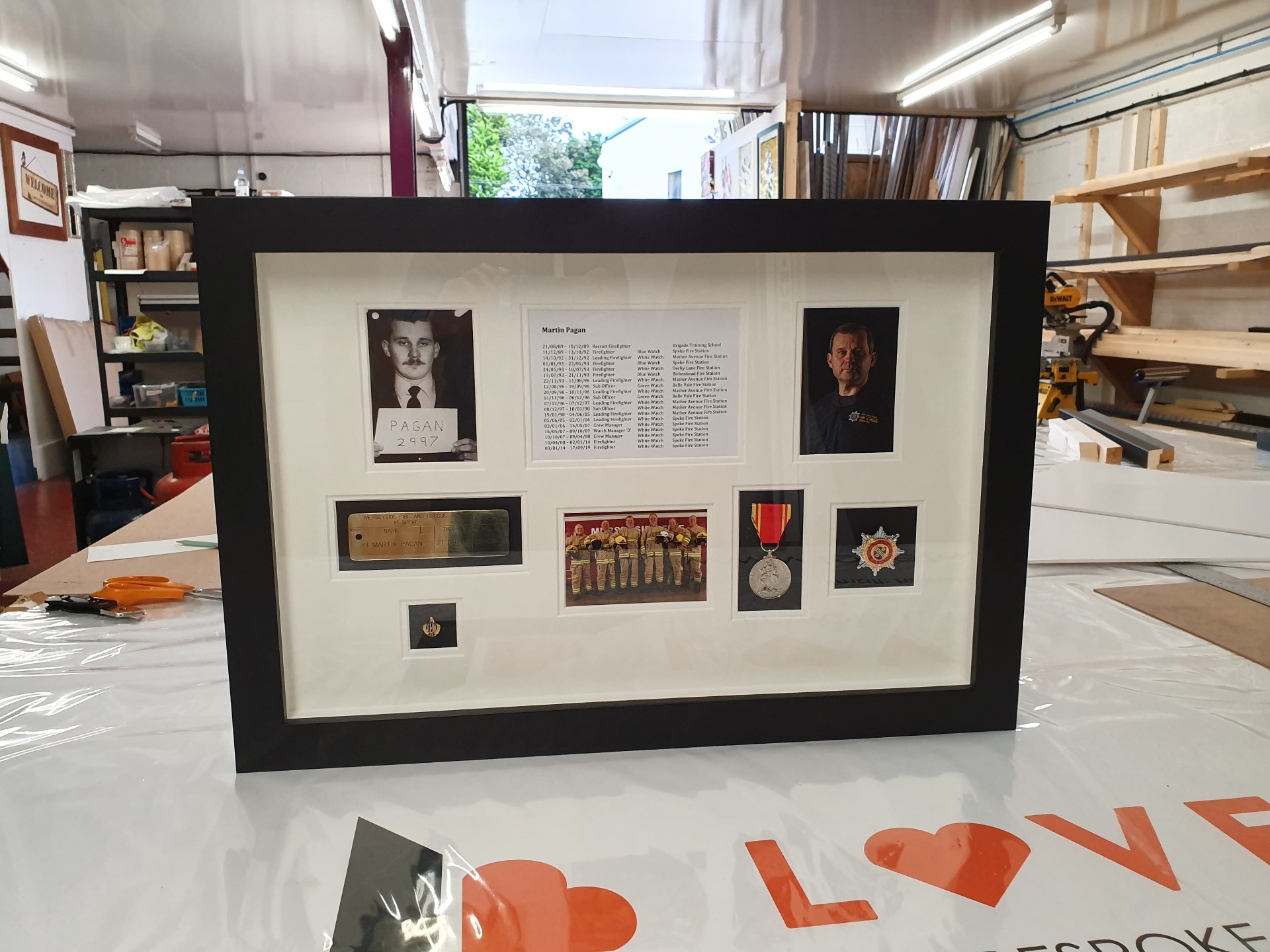
Documents are what turn a row of medals into a story, so the instinct to frame everything is a good one. The catch is light: paper and ink are far more sensitive than metal, and anything on paper hanging on a wall is on a slow clock. UV glazing buys decades, but nothing makes a document immune. Hence the rule we’d give anyone: frame a copy, keep the original dark. A reproduction of a citation, printed to the size the layout needs, looks identical behind glass.
What earns its place in the frame:
- A copy of the citation, typed service history or discharge certificate — the piece most visitors read first
- A reproduction of the portrait photograph — a 1940s original print is the most fragile thing in the box
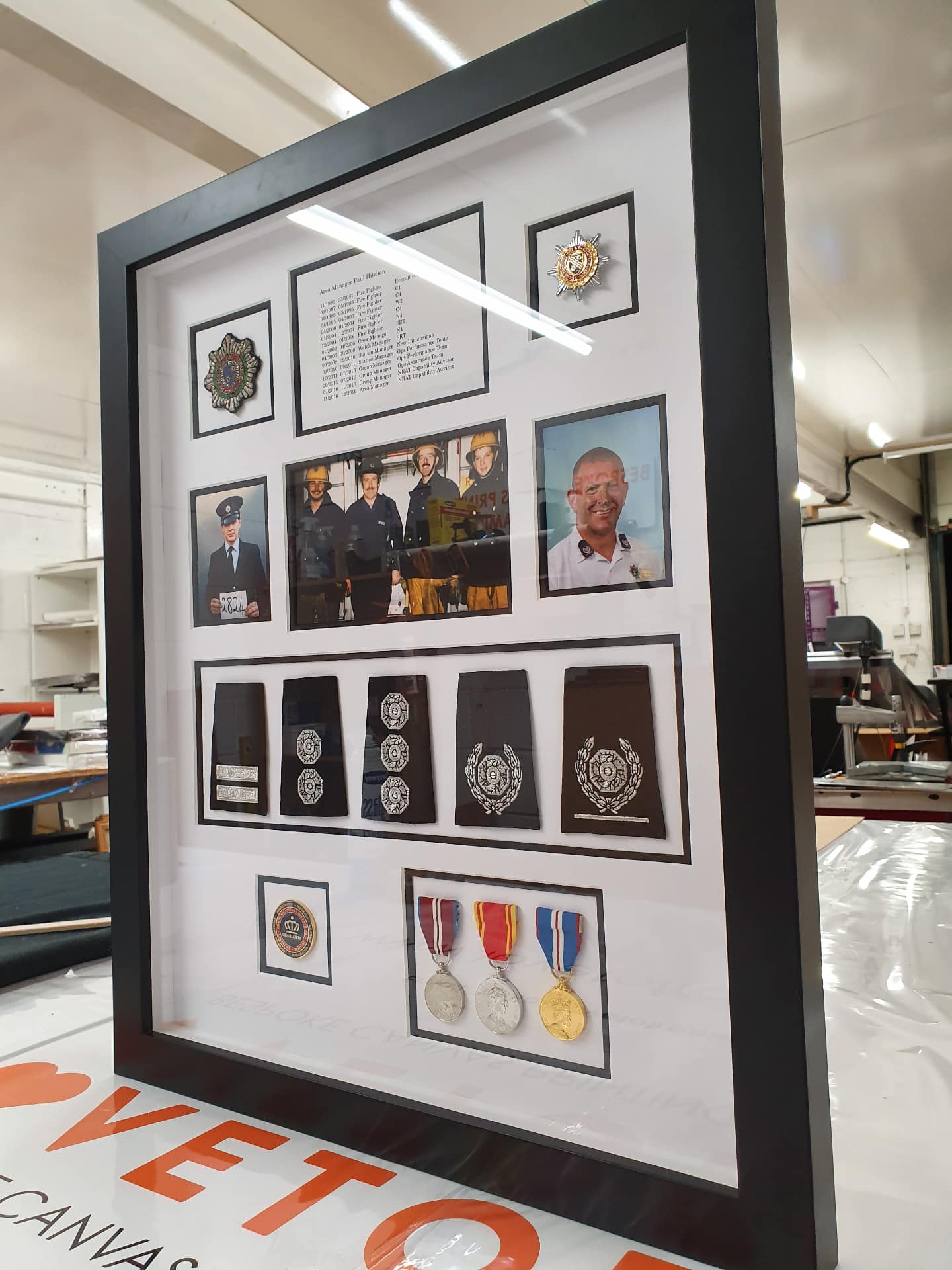
- Cap badges, insignia, rank slides and an engraved plaque naming the recipient, unit and dates — metal and cloth cope with display far better than paper
Better kept out: original citations, service and discharge papers, original photographs and letters, and anything you’d need for a valuation or an insurance claim. Store those flat and dark in an acid-free folder. Families often take a middle path: the copy goes in the visible layout, and the originals sit in an acid-free sleeve behind the backing board of the same frame — dark, flat, and never separated from the medals when a house is cleared. And whatever you do, never laminate a document: it’s permanent, and it destroys the value of anything historic.
Common questions
Which way round should the medals face? Obverse forward — the side carrying the monarch’s head or the principal design. If the naming sits on the rim or reverse, frame a photograph of it alongside rather than turning one medal the wrong way. Dress miniatures and the undress ribbon bar, if you have them, sit neatly beneath the full-size group.
How long does it take, and what does it cost? Turnaround and price bands for single medals, full groups and multi-aperture displays are all set out on our medal framing page. If you’re working to Remembrance Sunday or a milestone birthday, say so when you enquire.
Can the medals come back out later? Yes — nothing is drilled, glued or pinned through a medal, so a group can always be released to be worn, valued or sold. That reversible approach runs through our medal framing, memorabilia framing and sports memorabilia work alike.
Not sure of the order, the mounting, or what should sit alongside them? Send us a photo of the group and tell us about the person who earned it. We’ll say honestly what we’d frame, what we’d leave exactly as it is, and what we’d keep in a drawer.
Ready to start a project?