Signed photographs, match-worn boots and every awkward object in between — the three questions that decide any memorabilia frame, and the mistakes that quietly ruin a signature.
A signed photograph from a testimonial night. The boots from a debut. A cap, a race number, a ticket stub, a bat nobody outside the family will ever care about. Sports memorabilia turns up without instructions, and the difference between a display that still looks right in twenty years and one that quietly ruins the piece is decided long before anyone picks up a moulding.
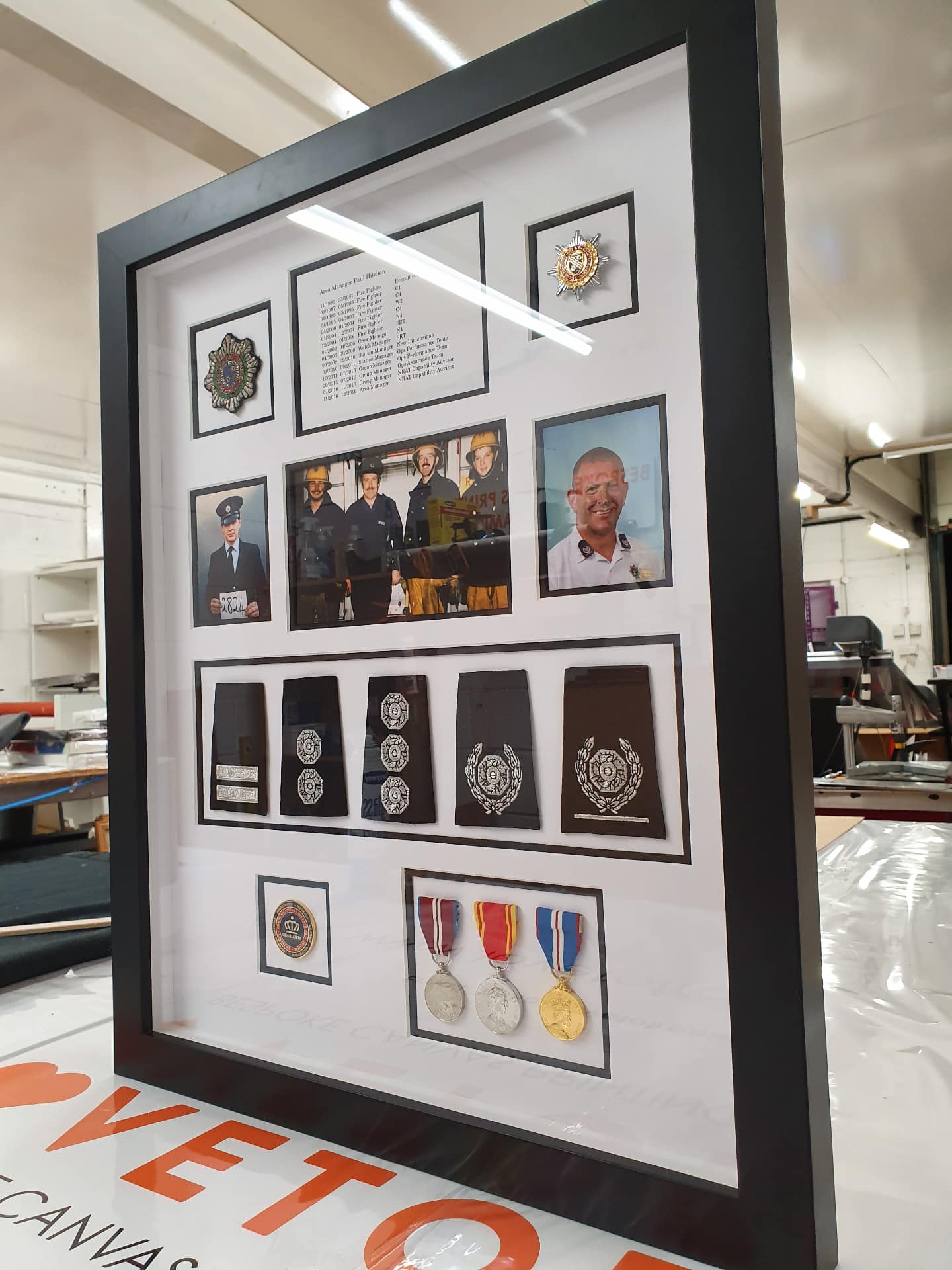
Shirts have a guide of their own and boxing gloves a whole page, so this one covers everything else — the two objects people most often get wrong, and a way of thinking that works for anything. Finished examples live on our memorabilia framing page.
Three questions decide the frame
Bats, caps, boots, trophies, race numbers, ceremonial swords, christening robes — every object we box-frame comes down to the same three questions.
1. How deep is it at its deepest point? Not its average depth — its deepest point, because that sets the rebate. A cap is barely 20mm at the peak and 80–90mm across the crown. Measure the fattest part, add clearance, and you have the box you need. An object squashed flat against glass is the commonest fault in frames people bring us to redo.
2. How is it supported — and what must never take the weight? Every object has a point that mustn’t carry it: on a boot the stitching, on a cap the crown seam, on a bat the binding twine at the splice, on a trophy the stem. Support the piece where it is genuinely strong and let everything fragile hang free. Gravity has decades to work on whatever you choose.
3. Does it need to come out again undamaged? For anything signed, match-worn or irreplaceable, always yes — which rules out glue, trimming, pins and heat-mounting, and means everything touching it must be acid-free and reversible. That’s the whole subject of our guide to conservation picture framing.
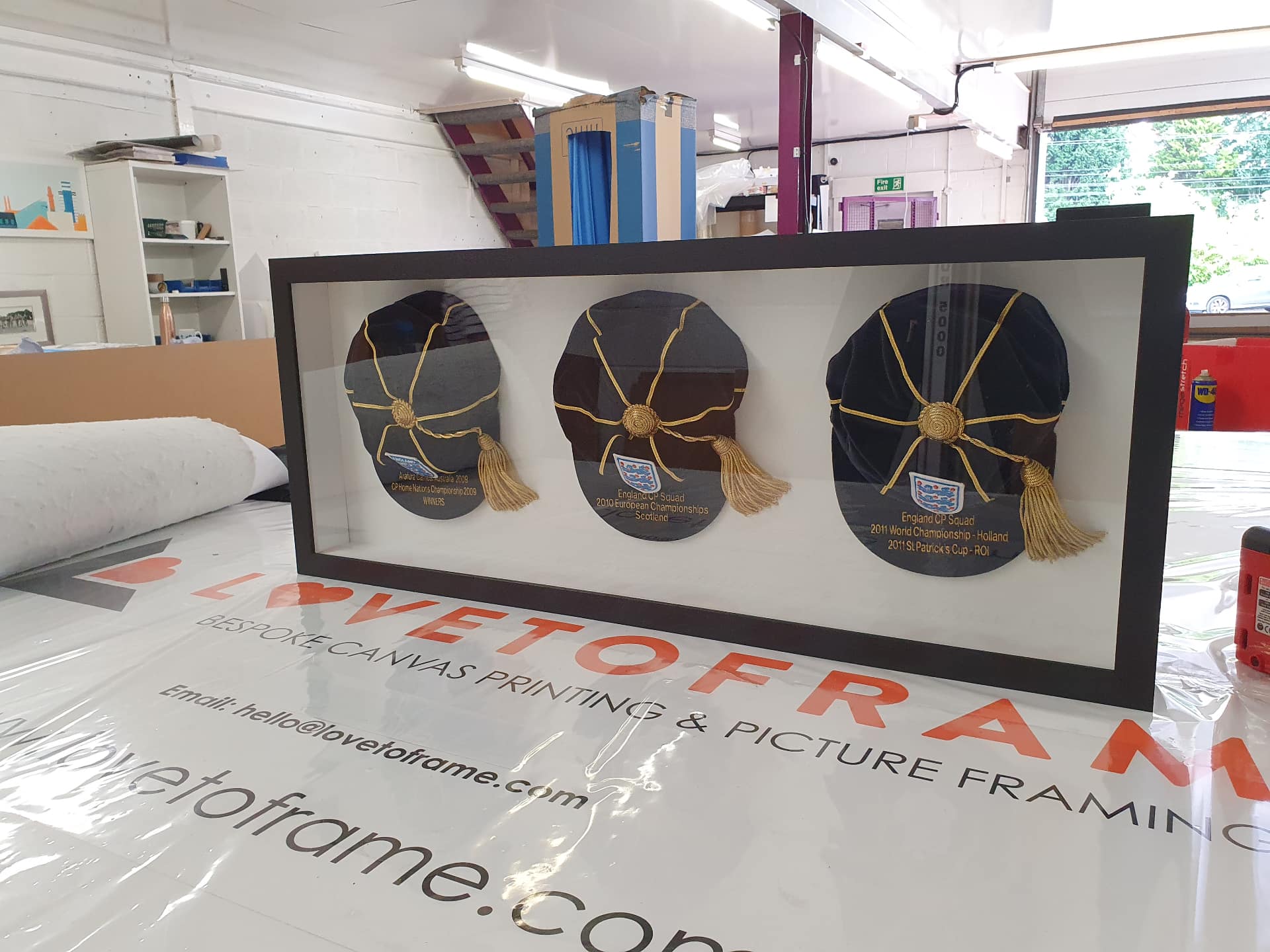
Five objects, five different answers:
- A cricket bat — heavy for its size, so the weight sits on the shoulders and toe, never hung from the handle binding. Give it space, or a 90cm bat looks stranded in its box.
- A cap — angle the peak slightly forward, or the embroidery that makes the cap worth framing points at the floor.
- A race number — flat, but paper, and creased by the pins that held it. Don’t flatten those creases: they’re the evidence it was run in.
- Ticket stubs — often thermal paper, which fades faster than anything else in a sports display. Cut apertures close so they aren’t swamped, and treat UV glazing as more urgent for them than for the big pieces.
- A trophy — weight travels down through the base, not out through the stem, and past a certain size the honest answer is a shelf.
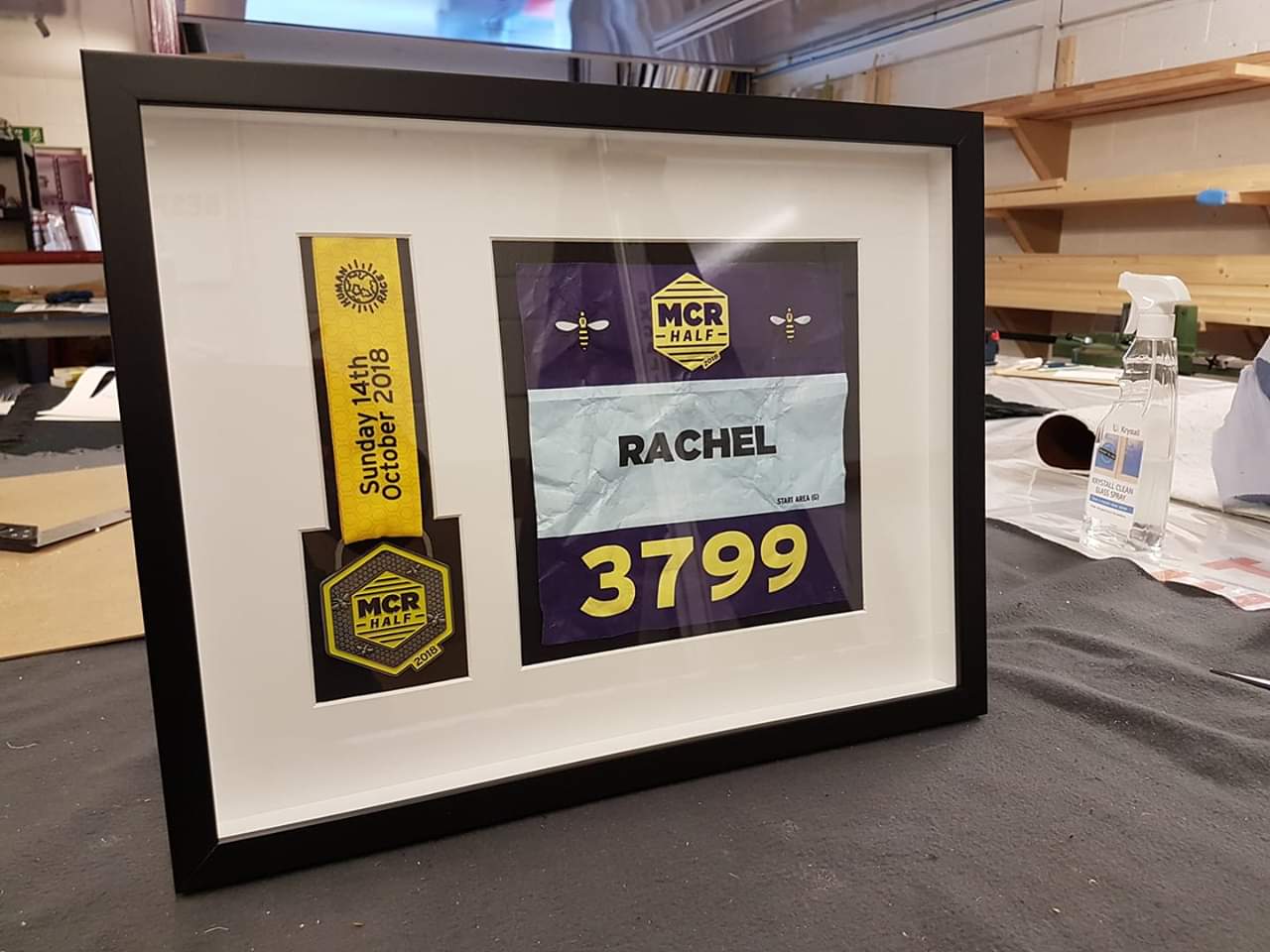
Signed photographs: the piece most often got wrong
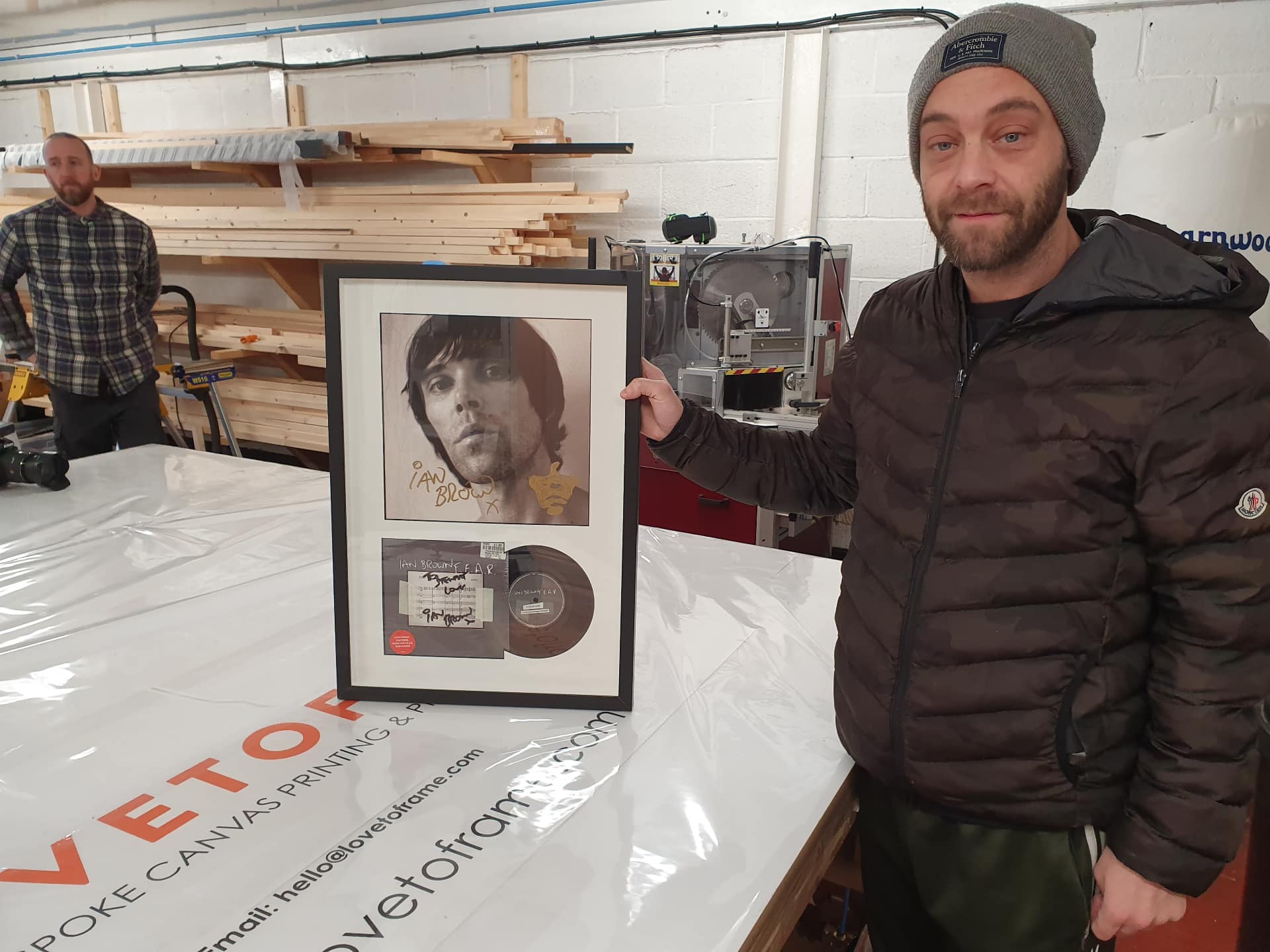
After shirts, signed photographs are the thing we’re asked to frame most — and the thing most often damaged before it reaches us. A photograph is two fragile things at once: a printed surface, and a layer of ink on top that was never designed to last.
The surface changes the signature. On a matt or satin print, marker ink sinks slightly into the coating and grips. On gloss it sits on the surface, stays faintly tacky far longer than seems reasonable, and can smudge under a thumb weeks later or lift if anything is laid on it. A photo signed on gloss should be treated as wet: face-up, and on its own.
Never dry-mount it and never trim it. Dry-mounting heat-glues a print permanently to board. It looks superb — perfectly flat, no ripples — and it is a one-way door that takes most of the value with it. Trimming a border to fit a ready-made frame is the other one-way door. A signed photograph stopped being a picture the moment it was signed; treat it as a document.
Keep the print off the glass. This is the rule that saves photographs. Emulsion and marker ink both soften in a warm, humid room, and a print touching glazing can bond to it — not smudge, stick, permanently, taking the image with it if anyone tries to separate the two. Nobody can undo that. So a signed photo sits either beneath a mount, which lifts the glass clear at the edges, or behind spacers hidden in the rebate if you want the full image with no mount.
UV glazing is for the ink, not the photo. A modern photographic print is reasonably stable. The signature isn’t. Marker and pen inks are among the most fugitive things we frame, and silver or gold pen on a dark print goes first. Behind ordinary glass on a bright wall a signature can be noticeably weaker in five years and a ghost in fifteen — which is why UV-protective glass is standard on every sports frame we build.
Handle it by the edges. Clean dry hands or cotton gloves, fingers on the border or the extreme corners only. Fingerprint oils etch into gloss over months, and they land where people instinctively grip — an inch from the signature.
Signed boots: the asymmetric problem
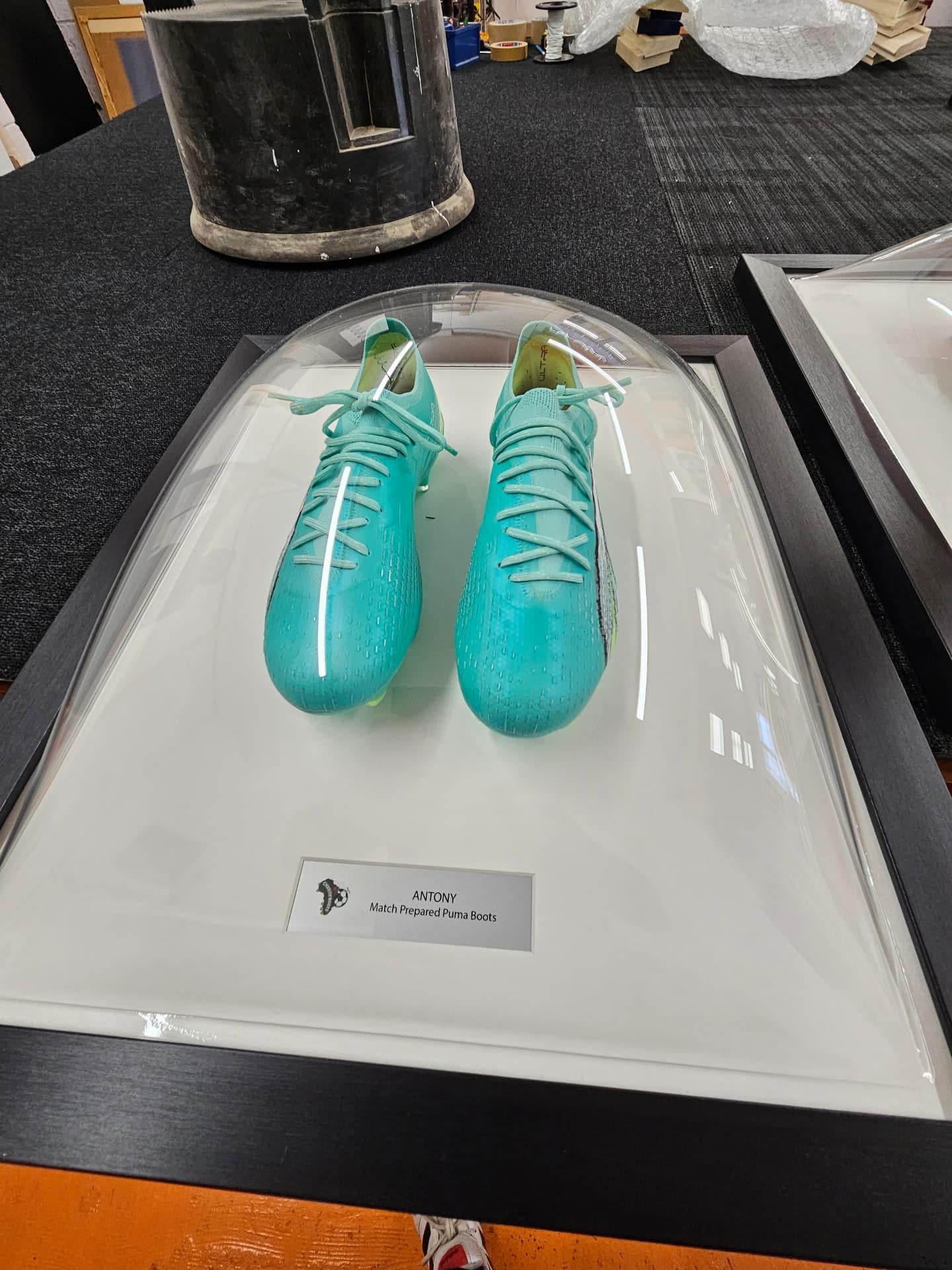
Boots defeat more standard box frames than anything else, because a boot isn’t one depth. It’s 30mm at the toe and 90mm or more at the heel counter, sloping the whole way between. Build to the average and the heel hits the glass; build to the heel and the toe floats in a cave. Angle the boot so the eye reads one continuous form, and size the rebate to its highest point as it sits.
Support the shape, not the seams. A boot has to hold its form for years without anything bearing on the stitching, so the support goes inside, in place of the last: the upper is held out from within and the weight travels down through the sole into the mount. What can never happen is a boot hanging by its laces or heel tab, or wedged between backing and glass — the first stretches the eyelet stitching, the second creases the toe box permanently.
Don’t clean match-worn boots. The dried mud in the studs, the grass stain across the toe, the scuff over the instep where the ball was struck a few thousand times — that’s the provenance. Wipe it off and what you have is a pair of second-hand boots. Tap away loose debris that would rattle around inside the frame; that’s the limit.
Arrange the laces first. Laces are what make a boot frame look composed or chaotic, and they shift every time the boot is picked up. Decide whether they’re tied, tucked or trailing, set them, and don’t touch them again.
One boot or two changes the whole frame. A single boot is a portrait — compact, deep, plaque underneath, happy in an alcove. A pair is a landscape almost twice as wide, and the two have to sit at matching angles or the display reads as accidental. It changes the proportion, the price and where the piece can hang.
Boxing gloves, in brief
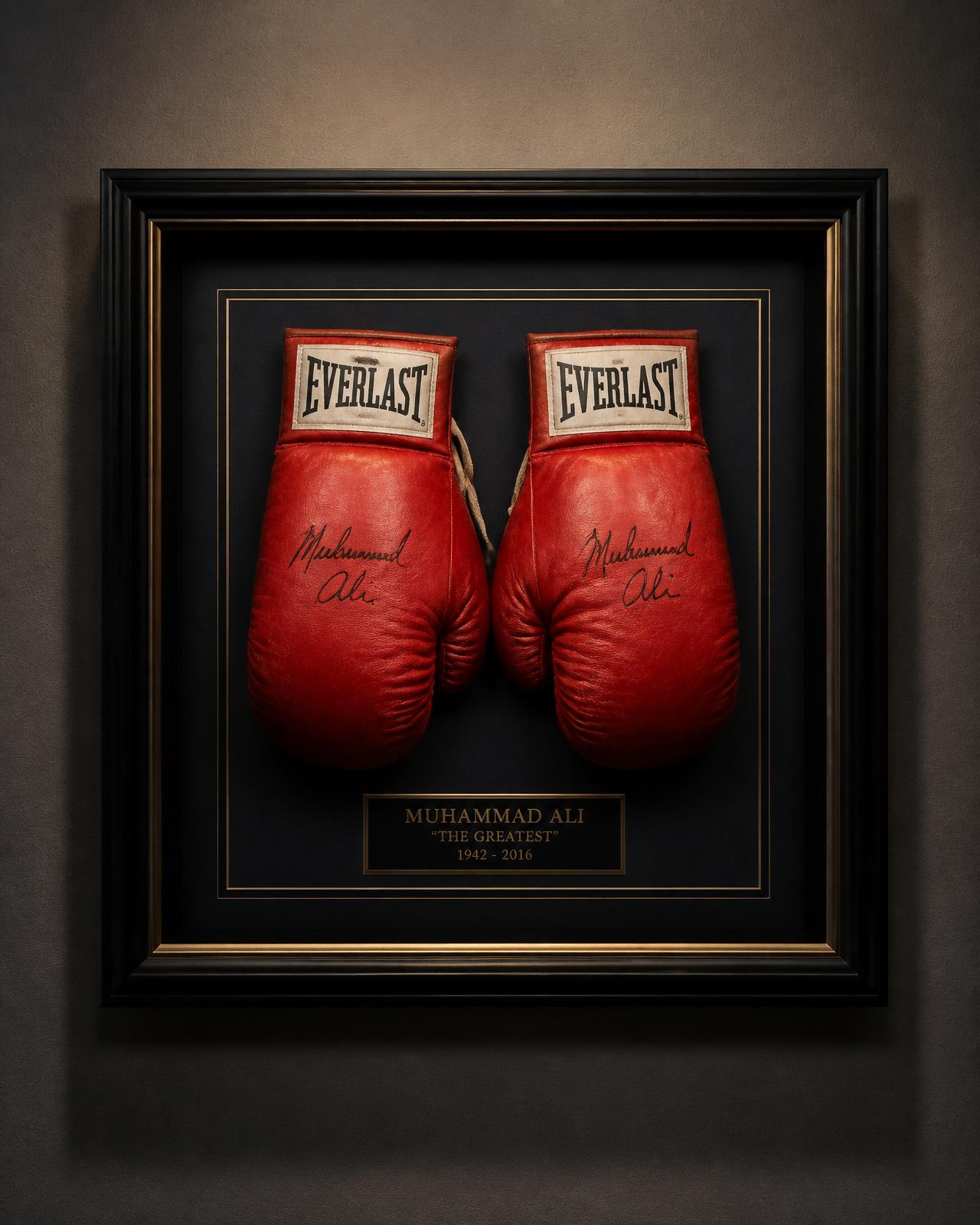
Gloves reach unusual answers on all three questions: they’re the deepest thing we routinely frame, they can’t take a fixing anywhere, and the signature normally sits on the most curved surface of the piece. That’s why they have a page rather than a paragraph — box depth, how each glove is held, and what a single glove or a signed pair costs are all on the boxing glove framing page.
Two things worth knowing. Glove framing takes longer than the rest of our memorabilia work — 10–14 working days against 7–10 — because the support is built around the specific pair. And vintage lace-ups behave nothing like modern gloves: the leather has hardened and the laces gone brittle, so they are arranged once and left alone.
Shirts and medals, in a line each
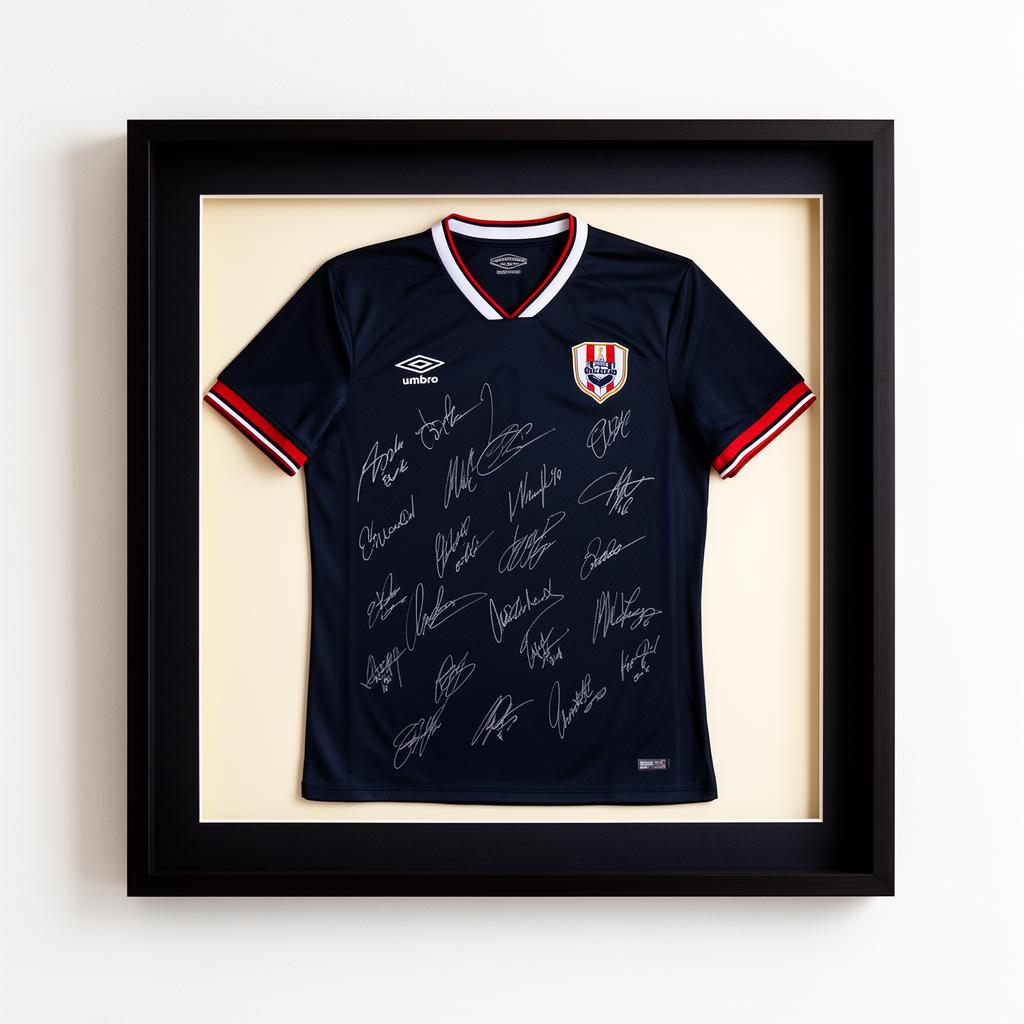
Shirts work differently — no rigid object to support, just fabric that has to be given a shape and held in it for decades without a single pin. Folded or full-front, sleeves shown or tucked, which face tells the story: it’s all in our guide to framing a football or rugby shirt, which also covers cricket and lacrosse kit.
Medals sit in between — small, heavy for their size, and governed by conventions of order and ribbon. Our guide to framing medals covers mounting order and ribbon etiquette, and the medal framing page shows the layouts.
Common questions
Should I clean an object before framing it? If it was used in anger, no. Mud, grass, sweat marks and scuffs are the provenance, and removing them removes the story and, on anything saleable, some of the value.
Can you frame something that isn’t a standard shape? Usually — we’ve built boxes for cricket bats, caps, vinyl, instruments, christening robes, first shoes and ceremonial swords. Send a photo and we’ll tell you honestly.
What does it cost, and how long does it take? It depends entirely on the object’s depth and how many pieces share the frame, so current price bands and turnaround live on the memorabilia framing page — and on the boxing glove framing page, which runs to its own timescale.
Could the object come out again later? Yes. Nothing is glued, pinned through or heat-mounted, so a boot, cap or photograph lifts out exactly as it went in — which matters for insurance and for anyone who ever sells the piece.
Not sure what your piece needs? Send us a photo and the rough dimensions — one straight on and one from the side, so we can see the depth — and tell us the story behind it. We’ll come back with a layout and an honest quote, usually the same day, and if the piece would be better on a shelf than in a frame we’ll say so. Finished work is collected from Timperley or double-boxed and shipped UK-wide by insured courier — or call the workshop on 0161 669 1835.
Ready to start a project?