How to protect original paintings and works on paper at home — light, humidity, handling, storage and transport advice from our Timperley framing studio.
An original is the one copy that exists. A print can be reprinted and a file restored from backup, but if the painting on your wall fades, warps or grows mould, that’s it — there is no undo. The good news is that nearly all the damage we see arriving at our Timperley workshop is slow, predictable and preventable, usually at no cost at all. Here’s the practical version: what actually harms artwork in an ordinary home, what to do about it, and the point at which you should put the cloth down and call a professional.
Light is the number one enemy
Direct sunlight is the single biggest killer of original artwork, and the cruel part is that the damage is cumulative and irreversible. Every hour of exposure does a little more harm, none of it can be restored, and by the time you notice a watercolour has gone pale or a signature has vanished, years of fading are already baked in.
Works on paper are the most vulnerable — watercolours, inks, pastels and older prints use pigments and dyes that can shift visibly within a few years on a sunny wall, and the paper itself yellows and turns brittle. Oils and acrylics are tougher, but they’re not immune: pigments still fade and varnish yellows and degrades. There’s a reason galleries light works on paper at around 50 lux — roughly the brightness of a dim hallway.
You don’t need to live in the dark. Two moves solve most of it:
- Hang originals on walls that never take direct sun — walls at right angles to the window, hallways, stairwells and north-facing rooms are all naturally kind to art.
- Use UV-filtering glazing — conservation glass and acrylic filter up to 99% of UV, and they’re a standard option on our bespoke framing service. Our companion guide to conservation picture framing explains the full protective package — glazing, acid-free mounts and sealed backing.
Heat, humidity and where not to hang
After light, the biggest threats are heat and moisture — and more specifically, swings in both. Canvas, paper and wood all expand and contract as conditions change; repeat that cycle often enough and you get cracked paint, cockled paper and slack, wavy canvases. A quick reference:
| Location | The problem | Safer option |
|---|---|---|
| Opposite a sunny window | Cumulative UV fading — irreversible | A wall with no direct sun, plus UV glazing |
| Bathroom | Steam and humidity spikes; mould loves it | Replaceable prints only — never originals |
| Kitchen | Grease film, heat and humidity swings | A reproduction print of the original |
| Above a radiator or fireplace | Rising heat dries and cracks paint | Any wall away from heat sources |
| Exterior wall in an older house | Cold surface plus condensation = damp and foxing | Interior walls |
| Loft, garage or cellar | The worst temperature swings in the house | An interior room, upright, off the floor |
If you want numbers: conservators aim for roughly 40–60% relative humidity and a steady 18–21°C. But don’t obsess over hitting gallery figures — stable matters more than perfect. A living room that sits a little warm all year is far kinder to a painting than a spare room that swings between damp and dry with the seasons.
One reassurance: a canvas that has already gone slack or wavy is usually recoverable. Re-tensioning is routine work for our canvas stretching and mounting service — it’s the paint layer, not the sag, you need to worry about.
Handling and cleaning — and when to stop
Most handling damage happens in the three metres between the wall and wherever the piece is going. The rules are simple:
- Two hands, always — one on each side, carried vertically. Never lift by the top edge of the frame or by the hanging wire; that’s how corners spring open and wires pull out.
- Rings and watches off before handling an unglazed canvas — one careless scrape is a conservator bill.
- Dust with a soft, dry brush (a clean goat-hair or sable brush is ideal) or a dry microfibre cloth on the frame, working top to bottom.
- Never use household sprays, polish or water on a canvas or work on paper. If you’re cleaning glazing, spray the cloth — never the glass — so nothing wicks under the frame edge.
And on the folk remedies you’ll find online — bread, cut potato, saliva — please don’t. Here’s the honest answer to “how do I clean an oil painting?”: at home, you dust it, and that’s all. If you can see flaking or lifting paint, a milky bloom in the varnish, mould spots, foxing on paper, a tear, or grime that a dry brush won’t lift, stop. That’s accredited-conservator territory, and any DIY attempt — damp cloths included — risks turning a modest professional clean into a major restoration. We’re framers and printers, not conservators, and we’ll tell you plainly when a piece needs one before any framing work goes ahead.
How to store paintings properly
Storage is where good artwork goes to die quietly. If a piece has to come off the wall for a while:
- Upright, never flat-stacked. Weight on a face-up painting stresses the canvas and anything placed on top will imprint it.
- Separate pieces with acid-free board, stored face-to-face and back-to-back so hanging hardware never touches a neighbour’s surface.
- Off concrete floors — concrete wicks moisture. A couple of timber battens is all it takes.
- Never the loft, garage or cellar. They have the most extreme temperature and humidity swings in the house — an interior room or cupboard beats all three.
- Drape with a cotton sheet, not plastic. Plastic traps moisture against the surface; cotton keeps dust off while letting the piece breathe.
Moving artwork without damaging it
Transport is short but high-risk. The essentials: fit corner protectors, sandwich the piece between two sheets of rigid board larger than the frame, and lay acid-free tissue or glassine against the surface first. The one mistake we see over and over is bubble wrap directly on paint or varnish — in a warm car it can imprint its bubble pattern into the surface, and on oils that mark can be permanent. Bubble wrap is fine as an outer layer over the tissue and board, bubbles facing out. In the car, transport the piece upright and wedged so it can’t slide or fall flat — never laid flat in a boot with anything else on top.
Keep the paperwork
Ten minutes of admin makes every future conversation — insurance, valuation, sale, inheritance — vastly easier. Photograph the front, the back, the signature and any labels; record the artist, title, dimensions, medium, date and where you bought it; keep receipts and certificates together and store copies digitally. Insurers will ask for exactly this if you ever claim, and provenance adds real value if the work is ever sold.
The strongest move: a museum-grade master file
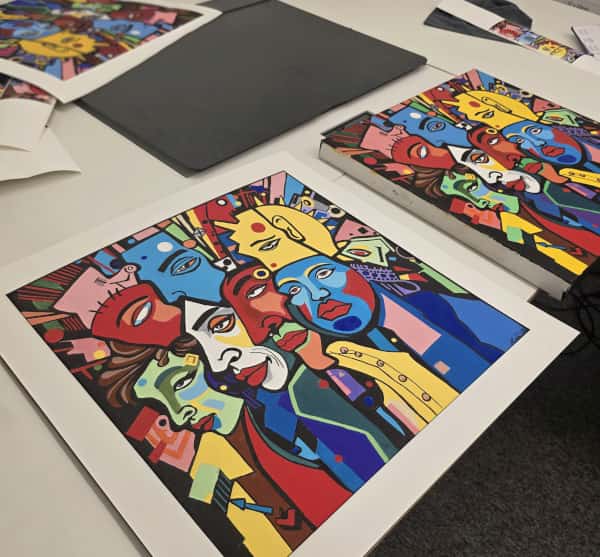
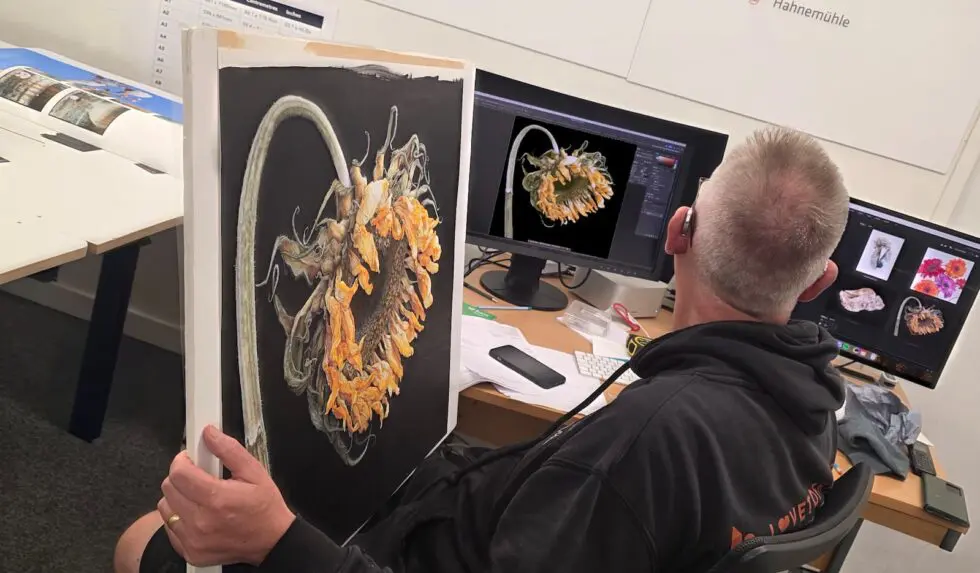
Everything above reduces risk; nothing eliminates it. Floods, fires and accidents don’t care how carefully a piece was hung. The single strongest thing you can do for an irreplaceable artwork is to have it professionally scanned so a museum-grade master file exists whatever happens. Our scanner captures originals up to 3m x 2m in a single pass at up to 1200 DPI, with 3D texture capture that records brushstrokes and surface detail — not just a photograph, a true archival record. For oil paintings especially, that file means a faithful reproduction can always be made, even if the worst happens to the original.
It also solves the hanging dilemma honestly: scan the original, hang a reproduction print in the sunny kitchen you actually want it in, and keep the original somewhere kind. Most scans are turned around in 3–5 working days, and the original never leaves careful hands.
Common questions
Can I clean an oil painting at home? Dusting with a soft, dry brush is the safe limit. Anything involving moisture, solvents or pressure belongs with an accredited conservator — especially if paint is flaking or the varnish has bloomed.
Does UV glazing stop fading completely? No — it filters up to 99% of UV, which slows fading dramatically, but intense visible light causes damage too. Glazing plus a sun-free wall is the combination that works.
Where is the safest place to hang original art? An interior wall with no direct sunlight, away from radiators, fireplaces, bathrooms and kitchens, in a room with a reasonably steady temperature. Hallways and stairwells are quietly excellent.
Is LED lighting safe for artwork? Broadly yes — LEDs emit negligible UV and little heat, which makes them the kindest way to light art. Keep spotlights at a sensible distance rather than inches from the surface.
If you’d like a piece protected properly — conservation framing, a slack canvas re-stretched, or a museum-grade scan of something irreplaceable — get in touch or bring it along to the Timperley workshop. We’ll look at it with you and recommend only what the piece actually needs.
Ready to start a project?