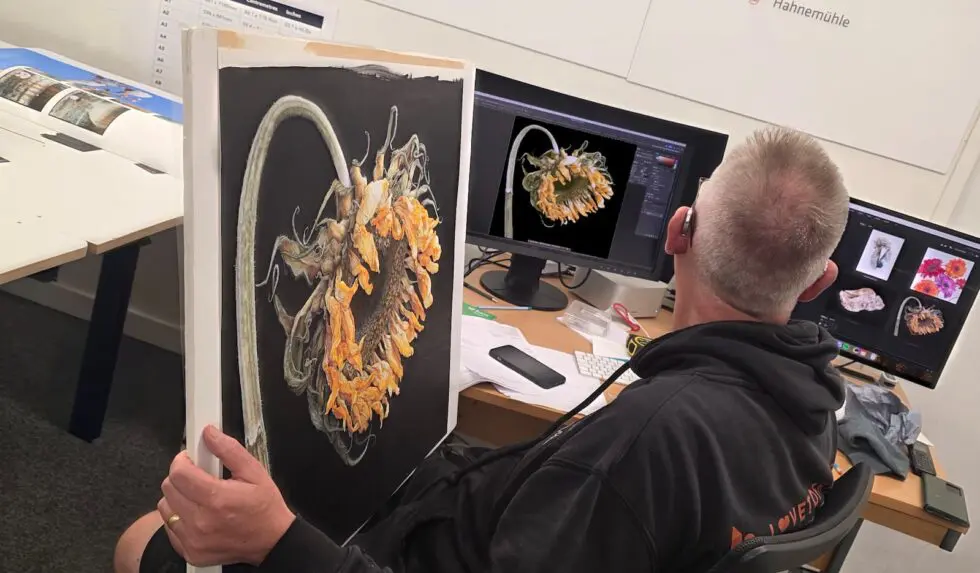
Oil Painting Scanning · Glare-Free Capture
Oil painting scanning and giclée reproduction — minus the varnish glare.
Photographing oil paintings fights hot spots, colour shifts and lost shadow detail. Scanning eliminates all three.
Instant Online Quote
Price up your oil painting scan in seconds.
Why Scan Oils
Varnish and glossy oils punish the camera. Not the scanner.
First, to be clear about what this service is: we scan and reproduce your own original oil painting as archival giclée prints. We don't paint copies of famous artworks and we don't sell hand-painted replicas — if you're an artist, or you own an original, and you want faithful glare-free prints of the real thing, you're in the right place.
Every professional photographer knows the pain of shooting an oil painting: polarising filters, cross-polarisation rigs, hours of retouching. The end file still shifts colour where varnish catches the light.
A contact-flatbed scanner ignores glare entirely. The sensor sees the paint surface, not the reflection. Colour is calibrated to reference, shadow detail is preserved, and the file is edition-ready straight off the bed.
What You Get
Four things this service is built around.
No hot spots, no reflections
Contact flatbed capture — the sensor sees the paint, not the varnish gloss.
Deep-shadow detail retained
36-bit colour holds highlight and shadow gradients photography clips off.
Impasto & brushwork read true
3D mode captures the raised surface — reproductions look like paintings, not posters.
Colour matched to the original
Calibrated colour workflow with test strips on Hahnemühle paper before edition.
The Process
How we reproduce your oil painting.
- 01
Delivery
Bring the original in person or ship insured. We accept originals dry to the touch — no wet varnish.
- 02
3D scan
The painting is scanned face-up on the flatbed with 3D texture and calibrated colour.
- 03
Colour match & proof
You approve a soft proof on screen and, optionally, a physical test print on your final paper.
- 04
Print your edition
Open or limited giclée editions on Hahnemühle rag, canvas or the substrate of your choice.
Glare, Solved
Why oils defeat the camera — and how contact scanning wins.
Of everything that comes through the studio, oil paintings are the hardest medium to reproduce well. The varnish layer behaves like a mirror, throwing hot spots wherever a light source sits. Impasto ridges cast their own shadows under studio lighting, so texture reads as noise rather than brushwork. And the deep darks oils are loved for — umbers, Prussian blues, glazed shadows — collapse to flat black the moment a camera exposes for the mid-tones. The standard workaround is cross-polarised photography: polarising film on the lights, a filter on the lens, and hours of retouching afterwards. It suppresses most of the glare, but it also deadens the surface, shifts colour where the polarisation is incomplete, and still clips detail in the darkest passages.
Contact scanning sidesteps all of it. On the flatbed, the sensor travels millimetres above the paint under diffuse, even light — there's simply no reflection path for varnish gloss to bounce back into the capture. The scanner records what's in the paint, not what's on top of it. And because the capture is 36-bit colour at up to 1200 DPI, the tonal gradients photography clips off — the difference between a glazed shadow and a dead black — survive into the file. When people search for how to scan an oil painting properly, this is the honest answer: keep the sensor close, keep the light diffuse, and glare never happens in the first place.
Then there's the surface itself. Our 3D texture mode records the raised topography of the painting — brush strokes, palette-knife marks, the ridge where one colour was dragged through another — as data alongside the colour capture. Reproduced in print, that texture information is what makes a giclée of an oil painting read as a painting on the wall rather than a poster of one. It's the single biggest reason artists across the UK ship oils to our Timperley workshop instead of booking a photographer locally.
From Scan to Edition
What happens between the scan and the finished print.
A good scan is the start, not the finish. Once your painting is off the bed, we colour-match the file against the original itself, side by side under controlled lighting — not against a photograph or from memory. Oils are full of colours that misbehave in reproduction, deep reds and violets especially, so this stage is done by eye as well as by profile. You approve a soft proof on screen first, and for anything heading to an edition we strongly recommend a physical test strip on your final paper: a small printed section held next to the original is worth more than any monitor.
Substrate matters more with oils than with any other medium. Hahnemühle German Etching is the classic choice — its heavyweight, textured mould-made surface flatters painterly work and takes deep colour beautifully. Photo Rag suits smoother, more blended styles. And for a like-for-like reproduction, we print on canvas with pigment inks and hand-stretch it over bars in the same workshop, so the finished piece hangs with the same presence and profile as the original. If your goal is simply to print your oil painting on canvas so a sold original can stay on your own wall in spirit, that's the route we'd point you down.
From one approved master you can run the edition however suits you. Many artists pair a signed, numbered limited edition on German Etching at a collector price with an open canvas or paper edition at an accessible one — both produced from the same file, both matched to the same approved proof. Because we scan, proof and print under one roof, there's no handover between a scanning bureau and a print house where colour quietly drifts; the profile that captured your painting is the profile that prints it.
Practicalities & Pricing
What it costs, and how the logistics work.
Pricing is straightforward: artwork reproduction starts from £20 at A3, and larger sizes are quoted by dimensions. Because the flatbed takes originals up to 3m × 2m in a single pass, almost any oil painting goes on whole — no stitching, no surcharge structure for awkward sizes, just a quote based on the area scanned. Use the scanning calculator for an instant figure, or send us dimensions and a phone snap of the painting and we'll confirm a fixed price for the scan, first proof and any edition printing together, so you can see your cost per print before committing.
On logistics: your painting needs to arrive unframed and dry to the touch — no wet varnish, no freshly worked passages, since the artwork lies face-up in contact with the scanning environment. If the piece is glazed and framed, don't wrestle with it yourself; our framing workshop de-glazes before scanning and re-glazes afterwards as part of the job. Bring the original to us in Timperley in person, or ship it insured — and for anything large or valuable, talk to us first and we'll advise on packing and courier options before you book anything.
Turnaround from delivery to master file and first proof is typically 3–5 working days, with edition printing running alongside our standard fine art printing turnaround of 3–5 working days after sign-off. Once your edition is approved we archive the colour-managed master, so future runs are printed from the same file, matched to the same reference proof — order ten prints this year and ten more in three years and they'll sit side by side without a visible difference. Your painting is scanned once; the edition never drifts.
Related Reproduction Services
Explore the rest of the reproduction workshop.
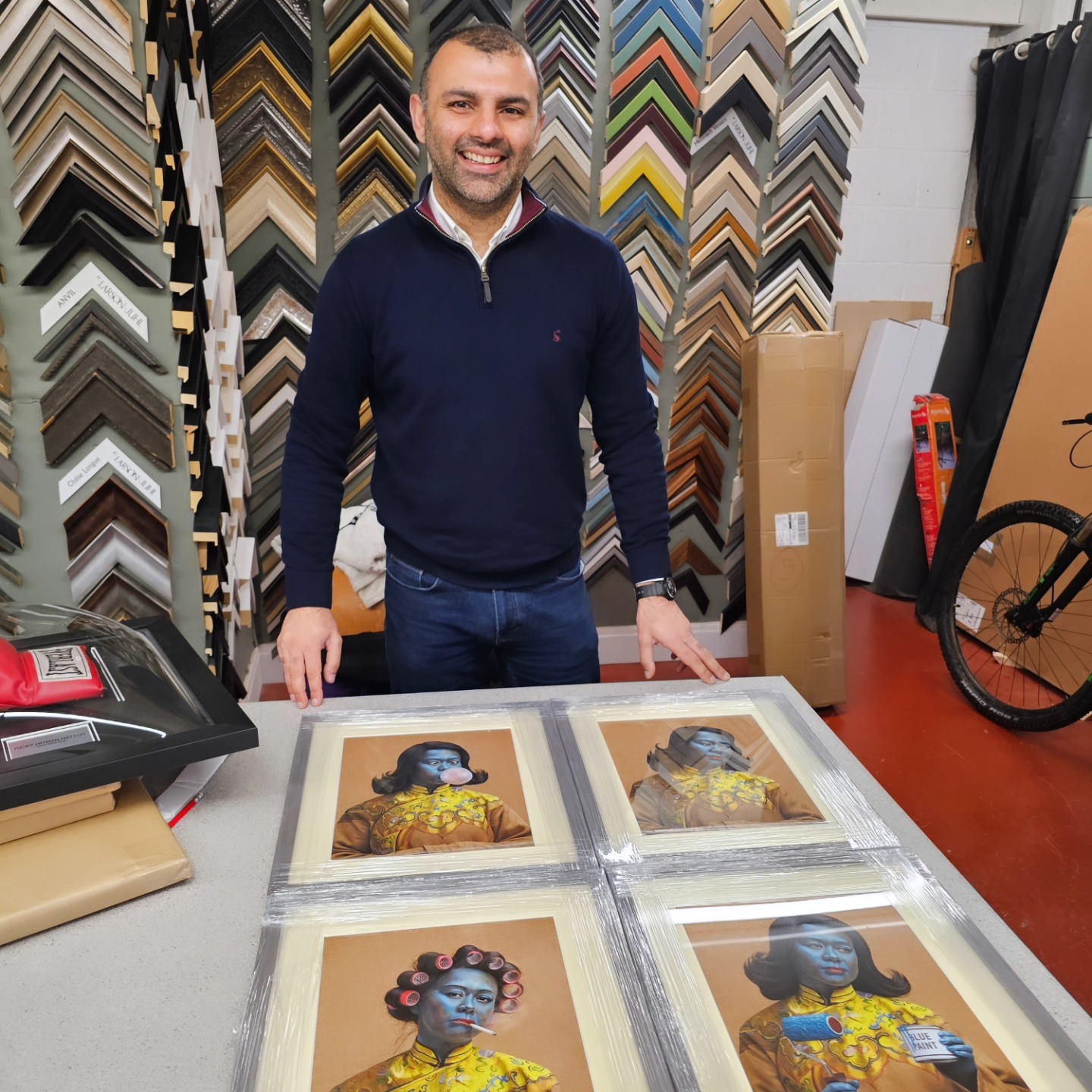
Large Format Art Scanning
Up to 3m × 2m in a single pass — no stitching.
Learn more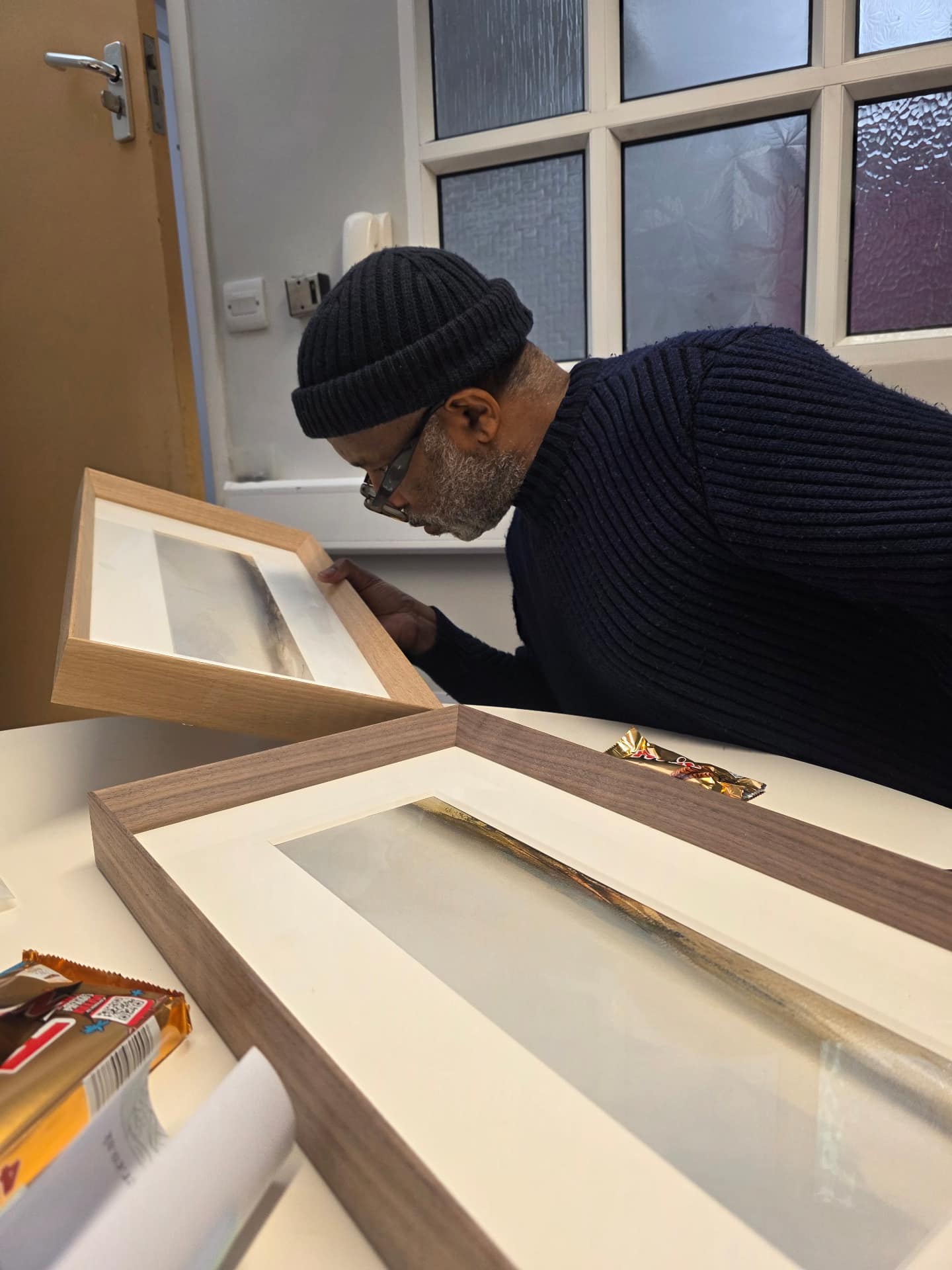
Limited Edition Prints
Signed & numbered giclée editions from your master file.
Learn moreLocal reproduction studios
We serve artists across South Manchester.
Frequently Asked
Oil painting scanning questions, answered.
No — that's a different industry entirely. We scan original oil paintings and print archival giclée reproductions from the resulting master file. The artwork we reproduce is yours (or your client's); we never paint replicas of other artists' work.
Get Started
Get your oil painting scanned and reproduced properly.
Send us dimensions and a phone snap of the original and we'll quote scan + first proof + edition pricing on your preferred paper.