Large Format Art Scanning · Up to 3m × 2m
Large format art scanning up to 3m × 2m — in a single pass.
Oversized originals shouldn't need stitching, distortion correction or a photography studio. Our flatbed handles them whole.
Instant Online Quote
Price your large format scan in seconds.
Beyond A0
For originals A0 and bigger, photography stops being an option.
Above A0 (roughly 84 × 119 cm), most scanning options run out. A0 flatbeds are rare; A1 and larger drum or wet-mount options are museum-only. Photography works — but distortion, uneven lighting and stitching seams start to creep in.
Our flatbed accepts originals up to 3m × 2m in a single pass. Every corner is captured under the same light and colour profile. There's no stitching, no correction pass — the file is edition-ready straight off the bed.
What You Get
What large format art scanning includes.
Up to 3m × 2m
One of the largest flatbed capacities in the UK — panels, murals, banners, oversized paintings.
One-pass capture
No stitching. No parallax. No lighting mismatch between quadrants.
1200 DPI throughout
Resolution is uniform across the entire scan bed — same fidelity in the corners as the centre.
Freight & handling advice
We advise on packing, insurance and courier options for oversized originals.
The Process
How large format capture works.
- 01
Talk to us first
For anything over A0 we like to discuss dimensions, weight and travel before you book.
- 02
Delivery
Bring it in person if you can. Otherwise we arrange an insured art courier — never a general parcel service.
- 03
Single-pass scan
The original is laid flat and scanned in one continuous pass with calibrated colour and 3D texture.
- 04
Master file + edition
You receive a full-resolution master and we print editions in-house up to matching sizes.
Courier & Crating
Getting an oversized original here safely.
Most of the risk in large format art scanning happens before the artwork reaches the scanner. A two-metre canvas doesn't fit a standard parcel network, and general couriers aren't set up for original art. So every oversized job starts with a conversation: tell us the dimensions, medium, support and where the piece is travelling from, and we'll agree the safest route before you book.
If you're within driving distance of our Timperley studio, bringing the work in person is usually simplest — we'll help unload and log the piece in on arrival. For everything else we arrange insured art couriers who handle originals for a living; we never route oversized work through a general parcel service. For stretched canvases and rigid panels we advise on flat-pack crating, so the surface travels protected without pressure on the paint layer.
Once your piece is with us it's logged in, stored flat and handled until it leaves the same way it arrived. Unstretched canvas and works on paper can travel rolled in heavy-duty tubes; stretched and panel works travel flat. Unsure whether your piece should travel at all? Ask — we'd rather talk through the options first.
Single-Pass Capture
What "single pass, no stitching" actually means.
Most studios capture oversized art in sections — a grid of frames stitched together in software. Done carefully it can look convincing, but every stitched capture carries the same compromises: lens distortion at the edge of each frame, lighting that shifts subtly between sections, and seams blended by hand through the most detailed parts of the image.
Our flatbed captures originals up to 3m × 2m in one continuous pass. The whole surface is recorded under the same light source, through the same optics, with the same colour profile — so a wash that runs from one corner to the other stays perfectly even, with no quadrant reading warmer or cooler than its neighbours. That colour uniformity is exactly what stitching struggles to guarantee, and at 1200 DPI across several square metres there is nowhere for a blended seam to hide.
The result is a file that's edition-ready straight off the bed: 1200 DPI corner to corner, 36-bit colour, and 3D texture data where the surface calls for it. No correction pass, no distortion fixes, no retouching seams out of the sky of your painting.
After the Scan
Large scans deserve large prints.
Scanning is only half the job. The same workshop prints large format giclée on our Canon PRO-4600 and PRO-6100 — printing up to 60 inches wide on roll paper and canvas with pigment inks. Because capture and printing happen under one roof, the colour profile that recorded your original is the same one that proofs and prints it.
As a Hahnemühle Certified Studio we print on papers matched to the work — Photo Rag, German Etching, Bamboo, Canvas Natural — and we produce open editions or signed, numbered limited editions from the same master file, archiving that master so future runs match the first.
You also receive the master itself: a full-resolution TIFF, with JPEG or PDF derivatives on request, ready for archiving, licensing or printing elsewhere. Scan-to-first-proof typically runs 3–5 working days, and edition printing sits alongside our standard fine art printing turnaround of 3–5 working days.
Related Reproduction Services
More from the reproduction workshop.
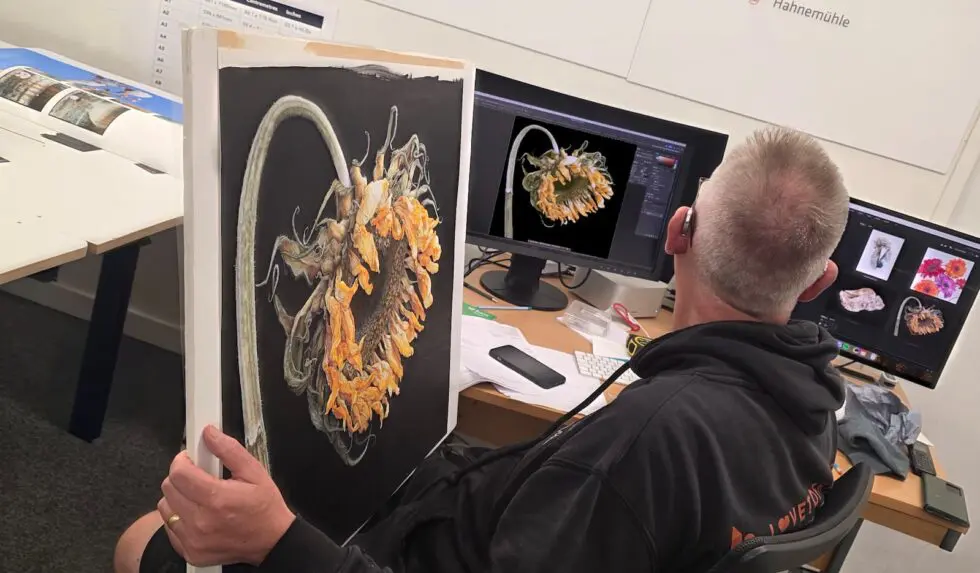
Oil Painting Scanning
Glare-free scanning and giclée reproduction of your original oils.
Learn more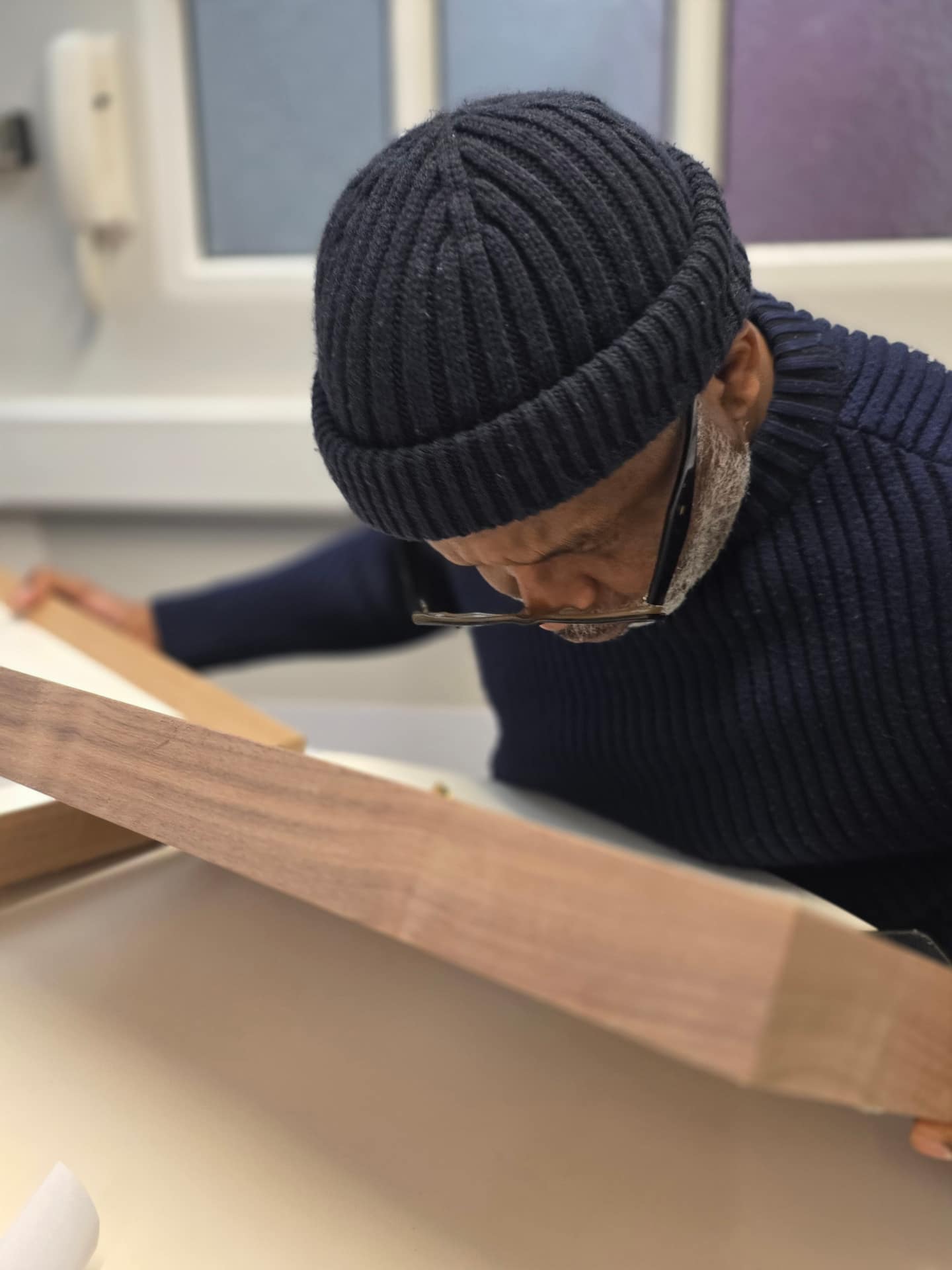
Galleries & Museums
Museum-grade scanning, archives and editions for institutions.
Learn moreLocal reproduction studios
We serve artists across South Manchester.
Frequently Asked
Large format scanning questions, answered.
Below 3m × 2m, no — everything is captured in a single pass. Beyond that we can stitch carefully, but a native single-pass file is always the better option.
Get Started
Got something oversized to scan?
Send us dimensions, medium and a photo — we'll come back with a quote for scanning, master file and any edition printing you want alongside.