Float frame or gallery wrap? What the shadow gap does, when a canvas needs a frame at all, and how 20mm, 25mm and 38mm bars pair with a moulding — honest advice from our Timperley workshop.
Canvases come into our Timperley workshop in two states — ready to hang, and in need of a frame — and their owners usually arrive with the same tangle of questions. Does a canvas need a frame at all? What exactly is a “floating” frame, and is it the same thing as a float mount? Why does nobody put glass on a painting? Here are the honest answers, and the handful of decisions worth making before any bespoke picture framing begins.
First, untangle the two meanings of “float”
“Float” is the most overloaded word in framing, because it describes two completely different things — and search results mix them freely.
A float mount is for artwork on paper. The sheet is raised on a hidden platform inside a glazed frame so that all of it — every edge, every deckle — stays visible, apparently floating above the mount board with a fine shadow beneath. It’s the way to frame a piece whose edges are part of its character: handmade paper, a deckled watercolour sheet, an old document. We cut float mounts in-house as part of our mount cutting service.
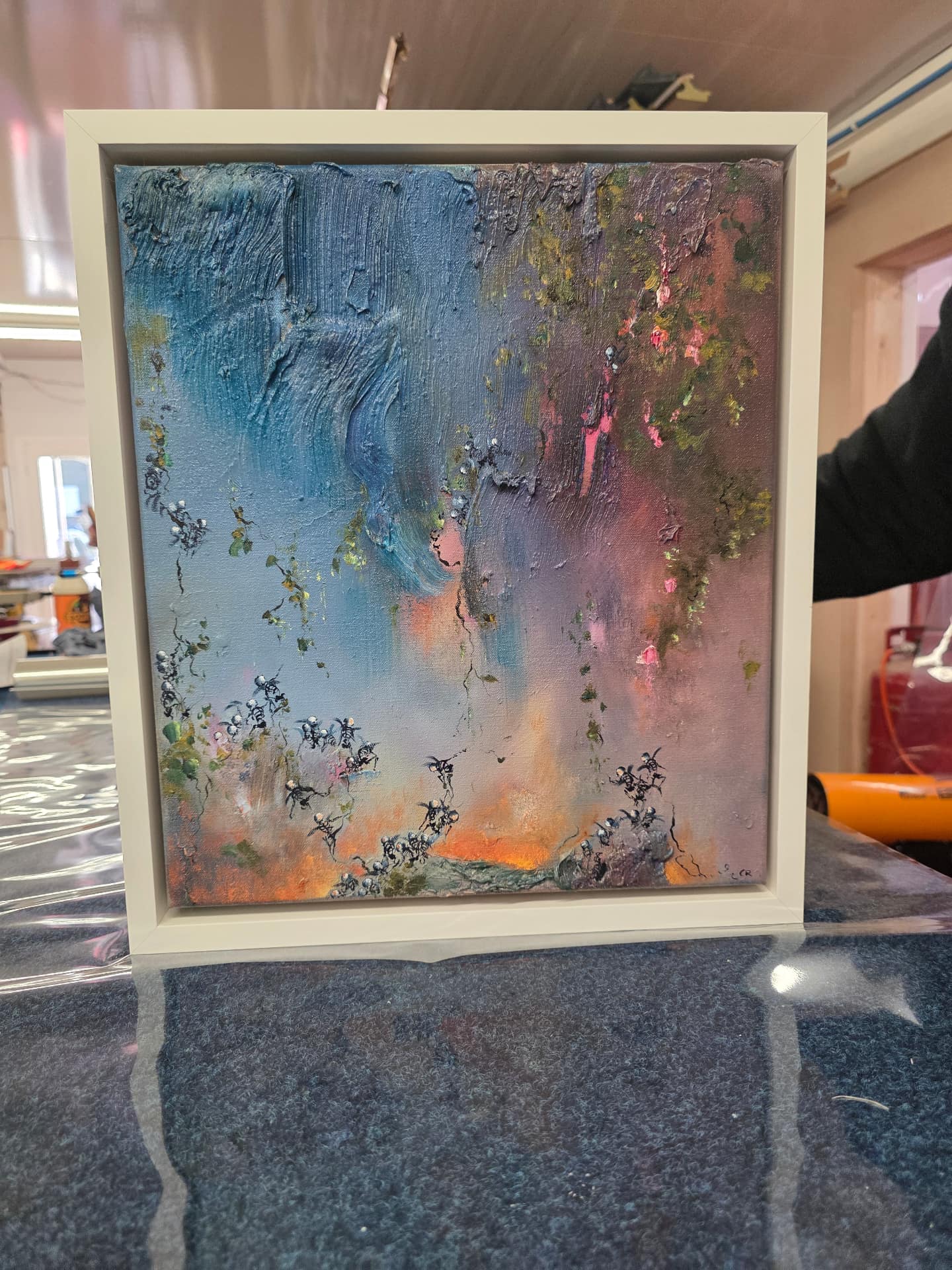
A float frame — also sold as a floater frame or tray frame — is for a stretched canvas. In section it’s an L-shaped profile: the canvas sits on the base of the L, inside the upright arm, with a deliberate gap running round every side and no glass anywhere. From the front, the canvas appears to float inside the frame, held by nothing.
If your piece is on paper, it’s the first of those you want. If it’s a canvas — painted or printed — read on, because the rest of this guide is about the second.
Why a canvas isn’t framed like a work on paper
A watercolour needs the full apparatus of framing — a mount to hold it flat and clear of the glazing, glass to shield it — because paper can’t support or protect itself. A stretched canvas needs none of that, because it is its own structure: the bars hold the fabric drum-tight, and the whole thing hangs happily on a wall with no frame at all.
It’s also normally displayed unglazed. Oil and acrylic surfaces are made to be seen in open air — texture, brushwork and sheen are part of the point, and a sheet of glass flattens all three behind a layer of reflections. So the frame’s job changes completely: around a canvas, a frame isn’t sealing the artwork away from the world, it’s there for presentation and edge protection. Conservation thinking still applies — nothing fixed through the painted surface, everything reversible — and our guide to conservation picture framing covers those principles in full.
The anatomy of a float frame
Three parts of the design decide how the finished piece reads.
The gap. The space between the canvas edge and the frame is deliberate and even — typically 5–10mm on every side. Too tight and it reads as a mistake; consistent and generous, it becomes a fine line of shadow drawn around the painting.
Proud, flush or recessed. The canvas face can sit slightly proud of the frame’s front edge, so the painting leads and the frame sits behind it — or flush with it, for a cleaner, more architectural line. A deep tray can even recess the canvas a touch. None of these is “correct”; they’re different characters, chosen to the painting and the room.
The fixing. The canvas is screwed to the frame from behind, through the base of the L into the stretcher bars. Nothing touches the painted surface, nothing shows from the front, and the whole thing comes apart in minutes if the canvas ever needs to travel or be re-stretched.
Together, that’s the float frame’s effect: the shadow line makes the canvas read as an object — a thing with edges and depth — rather than a picture behind a border. And unlike a traditional frame, whose rebate lip overlaps and hides a few millimetres of the image on every side, a float frame covers nothing. Every millimetre of the painting stays visible, edges included.
Float frame, gallery wrap — or a traditional frame?
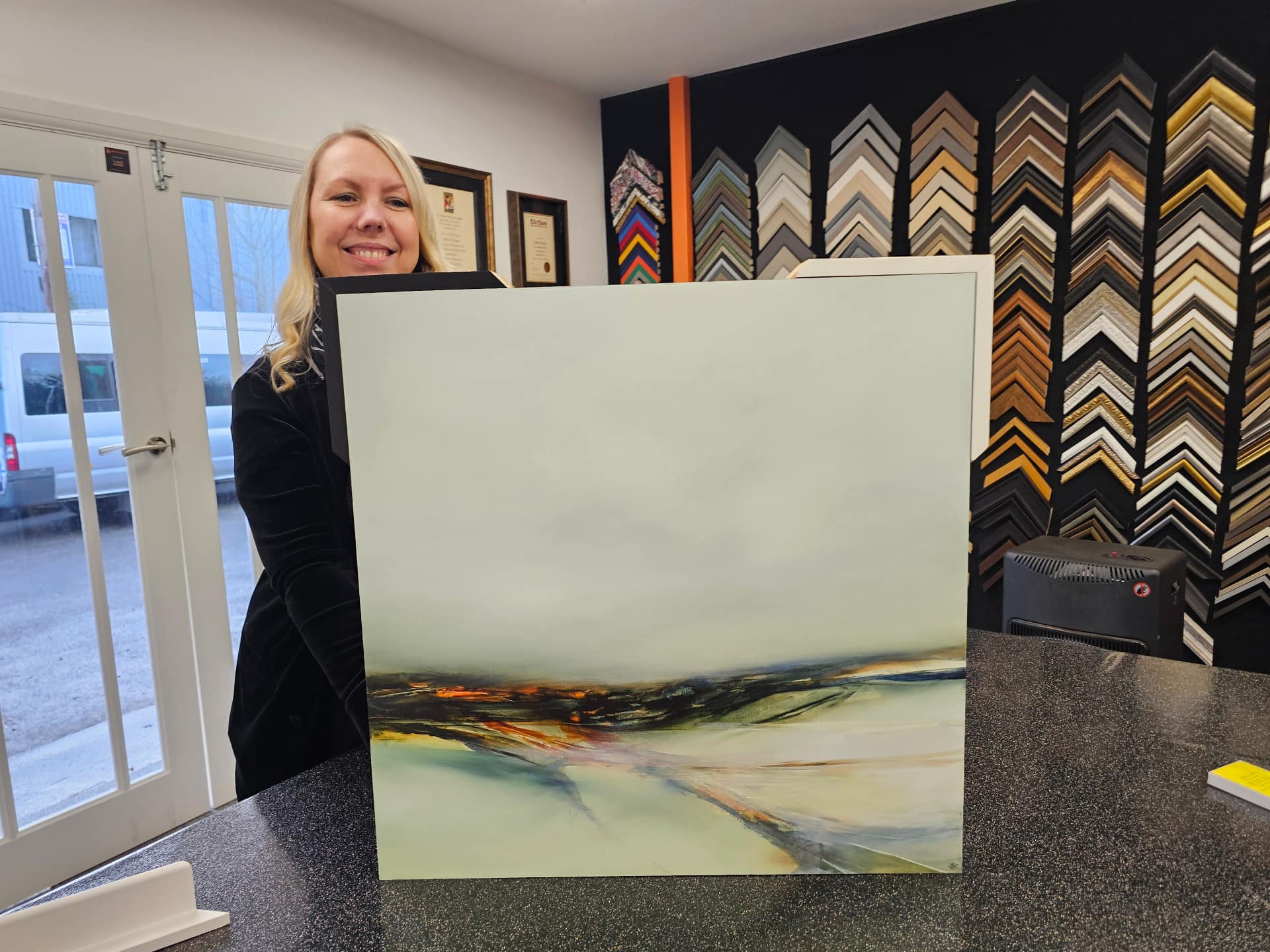
Plenty of canvases don’t need a frame at all, and we’ll tell you when yours is one of them. The honest way to decide:
A gallery wrap stands alone when the edges can carry it. A deep 38mm wrap with mirrored or fully wrapped-around edges is a finished object from every angle — contemporary, sculptural, and happiest unframed in a modern room. Framing one is never wrong, but it’s a taste decision rather than a necessity.
A float frame earns its keep in three situations. Slimmer bars — a 20mm or 25mm profile — sit close to the wall, and a float frame gives them the presence a big wall asks for. Unfinished sides — a hand-painted canvas where the paint stops at the face, leaving bare fabric, staples or drips on view — are exactly what the frame is designed to dress without hiding. And in a formal room where everything else is framed, an unframed canvas can look like it’s still waiting for something.
A traditional frame still suits some oils. A classical landscape or portrait in a gilt or ornate moulding is a look centuries old for good reason, and we build plenty of them. The trade-off is the rebate: a traditional frame overlaps the face of the canvas by a few millimetres on every side. If the composition runs hard to the edge, that’s the argument for a float frame instead.
| Gallery wrap alone | Float frame | Traditional frame | |
|---|---|---|---|
| The look | Contemporary, minimal, sculptural | The canvas reads as a floating object | Classic and formal, ornate if you like |
| The painted edge | On show — the sides are part of the display | Fully visible, ringed by a shadow line | Overlapped a few millimetres by the rebate |
| Best for | Deep 38mm wraps with finished edges | Slimmer bars, unfinished sides, formal rooms | Classical oils and traditional interiors |
Match the frame to the bar depth
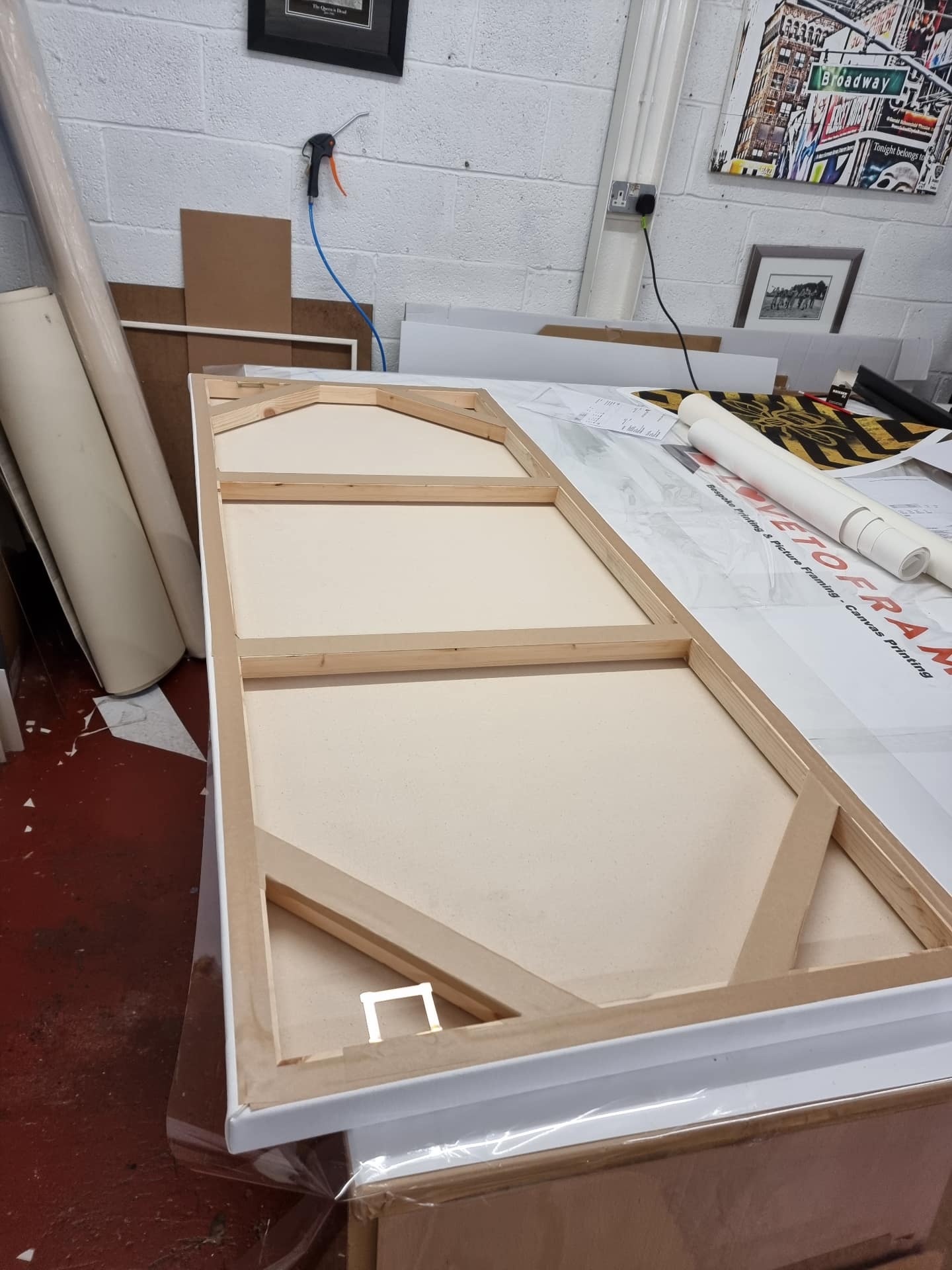
The one technical thing to get right: a float frame is built around the depth of the stretcher bars, so the moulding and the bars are chosen together. We stretch on three bar depths — 20mm Fine Edge, 25mm Slim Edge and 38mm Deep Edge — and each pairs differently:
- 20mm Fine Edge — slimline and close to the wall. Almost any float moulding will house it, usually with the face just shy of the frame’s front edge — the most understated pairing.
- 25mm Slim Edge — the classic gallery-wrap depth most float mouldings are designed around. Sit it flush for a clean line or slightly proud for a bolder one.
- 38mm Deep Edge — needs a genuinely deep tray. In a standard moulding it stands well proud of the frame, which can be a deliberately sculptural look — but it should be a choice, not a surprise.
Canvases stretched elsewhere arrive on every depth imaginable, which is fine — we measure the bars and choose the moulding to the canvas, never the other way round. If you’re unsure what yours are, measure the side of the canvas from the back to the painted face, or just bring it in.
If the canvas is slack or damaged, that comes first
A frame will never rescue a poorly tensioned canvas — ripples and sag are just as visible inside a float frame as out of it, and framing locks the problem in. A slack, dented or sagging canvas gets re-tensioned or re-stretched before any moulding is cut; that’s routine work for our canvas stretching and mounting service, and our guide to how a canvas is stretched shows exactly what happens on the bench.
Common questions
Can you float-frame a canvas print, or only a painting? Both — the frame doesn’t care what’s on the fabric. A printed canvas with mirrored or wrapped edges already stands alone well, so for prints it’s purely an aesthetic upgrade; our guide to canvas prints versus framed prints weighs the two presentations properly.
Will the frame touch the painted surface? No. A float frame is fixed from behind, through its base into the stretcher bars — the paint is never clamped, overlapped or even contacted, and the fixing is fully reversible.
Should a canvas ever go behind glass? Normally, no — canvases are displayed unglazed, and that’s how we’d frame nearly all of them. For a genuinely valuable painting hanging somewhere harsh we’d talk the options through honestly, but for most homes glass costs a canvas more in reflections than it saves in protection.
What does it cost, and how long does it take? Float frames are quoted on the piece — send us the canvas size and bar depth (a phone photo helps) via our contact page and we’ll come back with an honest quote, usually the same day. Bespoke framing runs 2–3 weeks, and if the canvas needs stretching first we’ll fold that into one timescale when you enquire.
Not sure whether your canvas wants a float frame, a traditional moulding or no frame at all? Send us a photo with the rough size and the depth of the bars — or bring it along to the Timperley workshop and hold some corner samples against it. We’ll tell you honestly which way we’d go, and if the answer is “hang it as it is”, we’ll say so.
Ready to start a project?